

 2025/12/20
A research team from Huazhong University of Science and Technology has proposed PAMR (Physics-Aware Aberration-Corrected Meta Neural Representation), a self-supervised 3D reconstruction framework for dynamic, label-free live-cell imaging. The study has been published in the peer-reviewed international optics journal Advanced Photonics Nexus.
PAMR: Methodological Advances in Label-Free 3D Tomography
Label-free 3D tomographic imaging has attracted growing interest in biological microscopy due to its low phototoxicity and simplified optical configuration. However, conventional Fourier Ptychographic Tomography (FPT) is often limited by pronounced reconstruction artifacts and high computational complexity, which restrict its applicability to dynamic live-cell observation and large field-of-view samples.
By integrating neural representations with physics-based priors, PAMR demonstrates systematic improvements over traditional approaches:
Accelerated volumetric reconstruction: The reconstruction time for a single 3D volume (585 × 585 × 120 voxels) is reduced from 250 s to 28 s, corresponding to an approximate 10× increase in reconstruction speed.
Resolution enhancement beyond the diffraction limit: Using a hemispherical illumination system with 66 LEDs in combination with a 40×/0.95 NA objective, PAMR achieves half-pitch resolutions of 137 nm laterally and 550 nm axially, representing an approximately twofold improvement over the objective diffraction limit.
Robust performance under sparse-view conditions: High-fidelity reconstructions are maintained with up to 75% view reduction. When the number of illumination angles is reduced from 120 to 30, reconstruction quality remains stable, with SSIM values significantly exceeding those obtained using conventional FPT methods.
FL 9BW Camera Support for PAMR Validation
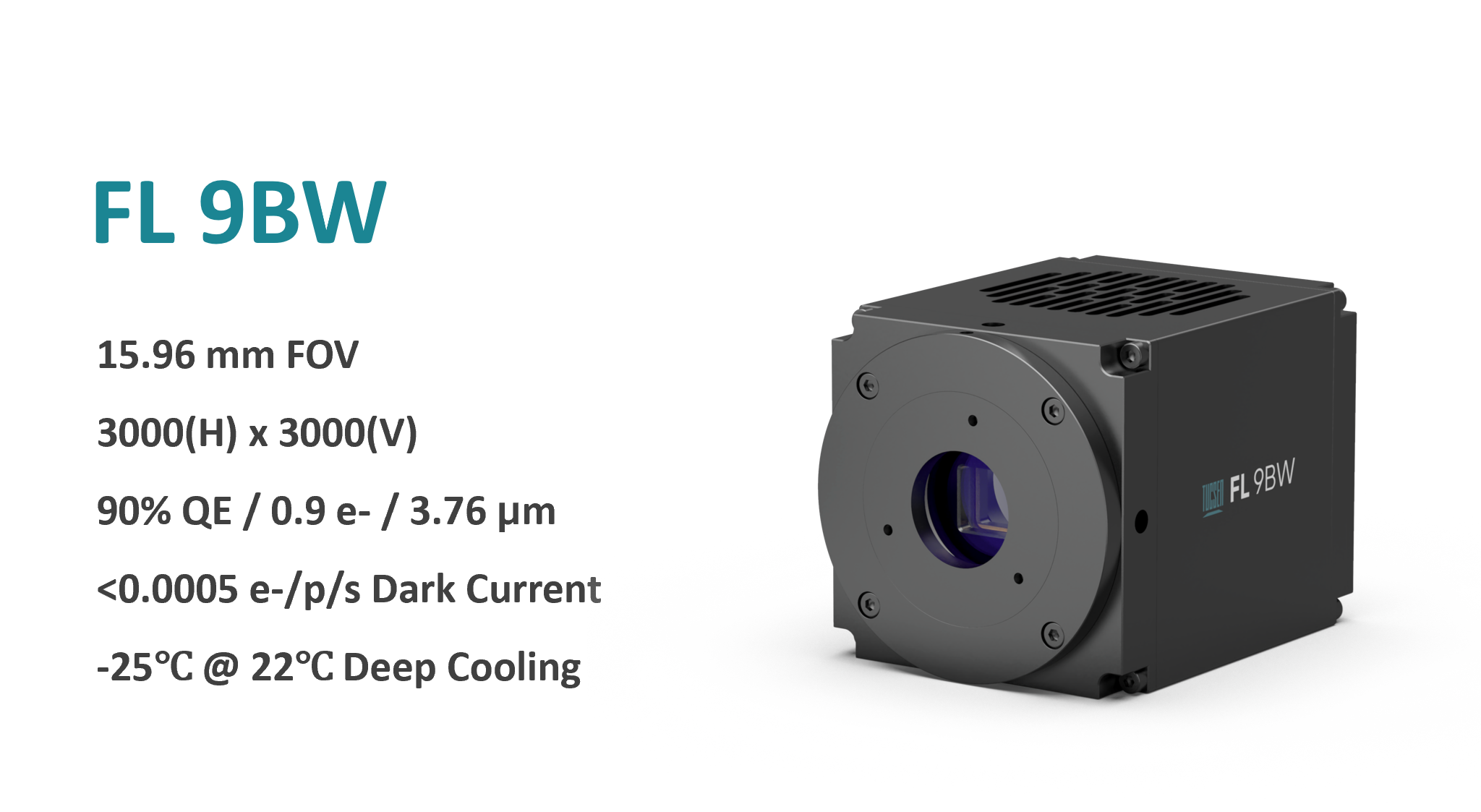
High-fidelity signal acquisition and imaging stability are critical for the experimental validation of advanced computational microscopy algorithms. The Tucsen FL 9BW scientific camera provides key hardware capabilities that support the PAMR framework.
High-Fidelity Signal Acquisition
A back-illuminated CMOS sensor with a peak quantum efficiency of 92%, enabling efficient detection of weak, label-free signals.
0.9 e⁻ read noise combined with an ultra-low dark current (< 0.0005 e⁻/p/s), minimizing noise contributions and preserving signal integrity under low-light conditions.
A 15.96 mm (1") large sensor format, allowing full coverage of heterogeneous sample structures, reducing information loss, and supporting the aberration-correction branch of the reconstruction pipeline.
High-Resolution Imaging Capability
A 3.76 μm pixel pitch, well matched to the diffraction limit of a 40×/0.95 NA objective and compliant with the Nyquist sampling criterion.
A 3000 × 3000 pixel array, enabling effective capture of multi-angle illumination data required for high-resolution computational reconstruction.
Long-Term Imaging Stability
The combination of ultra-low dark current (< 0.0005 e⁻/p/s) and deep cooling supports high signal-to-noise ratio imaging during long exposure times while mitigating phototoxic effects associated with high illumination intensity.
References
Sun M, Zhong F, Mao S, et al. Physics-informed meta neural representation for high-fidelity, aberration-corrected, sparse-view Fourier ptychographic tomography [J].
Copyright Notice: This article is intended to provide application references related to scientific cameras. Portions of the content are excerpted from relevant published research papers. All copyrights remain with the original authors. Please indicate the source when citing or reusing this material.


