

 2025/09/25
If you’ve ever worked with a scientific camera in microscopy, astronomy, or spectroscopy, you may have come across the term binning. For beginners, binning can seem like a technical detail buried in camera specifications, but in reality, it’s a fundamental concept that influences image quality, sensitivity, and even the speed of your experiments.
In simple terms, binning means combining multiple pixels into one larger “super-pixel.” While that sounds straightforward, the impact on resolution, signal, and noise is far from trivial. Whether you are a student stepping into fluorescence microscopy or an astronomer trying to capture faint galaxies, understanding binning is crucial to making the most of your scientific imaging setup.
What Is Binning? Binning Definition
Binning, also called pixel binning or image binning, is a process where signals from neighboring pixels on a sensor are combined into a single "super pixel."
In simple terms, binning adds together the charge from multiple pixels before readout. This increases the signal level and improves the signal-to-noise ratio (SNR), but at the cost of spatial resolution.
For example, in 2×2 binning, four adjacent pixels are combined into one. The resulting image has one-quarter the number of pixels, but each binned pixel contains more signal.
Scientific cameras offer the ability to increase pixel size electronically through binning. The signal collected by groups of pixels is combined into one ‘superpixel’, as shown in Figure 1. The most common form of binning is ‘2x2’ binning, where superpixels are formed from 2 rows and 2 columns of camera pixels. The pixel is then effectively 4x larger, conveying greater sensitivity, but reduced sampling ability, which may reduce resolution.
A simple analogy: imagine four small cups sitting side by side. If you pour the same amount of water into each, you’ll need to measure four times to know the total. But if you pour all the water into a single larger cup, you get the total in one go. The larger cup represents binning — more efficient collection, but less fine detail.

Figure 1: Binning camera pixels
Binning is electronically grouping pixels and summing the resulting signal. Pictured is 2x2 binning, combining 2 rows and 2 columns into superpixels. Larger values and asymmetric binning are also possible.
How Does Camera Binning Work?
Binning can be carried out in two main ways: hardware binning and software binning.
● Hardware binning: The charge (in CCDs) or the signal (in some CMOS/sCMOS) from neighboring pixels is combined directly on the sensor before readout. This reduces read noise because the system reads a single larger signal instead of multiple smaller ones.
● Software binning: Individual pixel signals are first read out separately and then combined by software. While it reduces image resolution, it doesn’t reduce read noise in the same way as hardware binning.
Common binning modes include:
● 2×2 binning: Groups 4 pixels into 1.
● 3×3 binning: Groups 9 pixels into 1.
● 4×4 binning: Groups 16 pixels into 1.
Effects:
● Resolution decreases in proportion to the binning factor.
● Signal-to-noise ratio (SNR) improves because more photons are collected relative to the noise. Learn more about how to affect SNR
● Data throughput improves since fewer pixels are read out, reducing file size and enabling faster imaging.
Why Is Binning Important in Scientific Imaging?
Binning matters because it lets you trade resolution for sensitivity and speed.
Increased Sensitivity
By combining signals from multiple pixels, binning increases the total signal per pixel. This improves SNR, especially in low-light conditions.
Faster Frame Rates
Binning reduces the number of pixels that need to be read out. This allows higher frame rates, which is useful for high-speed imaging.
Reduced Data Size
Binning produces smaller images, which reduces storage and processing requirements.
However, binning also has downsides. It reduces spatial resolution and can introduce artifacts if not used carefully.
Binning in Different Scientific Camera Technologies
Binning is achieved through different mechanisms with different sensor technologies. The way binning is implemented depends heavily on the type of camera sensor. Different technologies—CCD, EMCCD, CMOS, and sCMOS—handle binning in different ways, which directly affects sensitivity, noise performance, and imaging speed.
Binning is achieved through different mechanisms with different sensor technologies. CCD and EMCCD sensors bin by physically combining photoelectrons before readout, so called ‘on-chip’ binning. This conveys advantages in both speed and sensitivity. CMOS sensors typically only bin ‘off-chip’, meaning the pixel values are read then summed digitally. This still increases the signal-to-noise ratio of the sensor, but less than CCD and EMCCD sensors, and usually conveys no speed advantage. However, very rarely the sCMOS sensors are capable of on-chip binning, such as the Tucsen Dhyana 2100 sCMOS camera, which can then deliver extremely high frame rates.
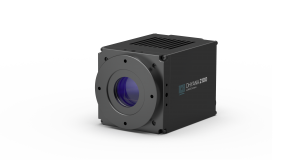
Below we compare how binning works across CCD/EMCCD, CMOS, and sCMOS cameras.
CCD and EMCCD Binning
In CCD and EMCCD cameras, binning happens directly on the sensor before the image signal is converted into digital values. This on-chip approach ensures that the signal from multiple pixels is combined first, and only then is read noise introduced.
The result is twofold:
● Improved sensitivity: Combining pixels increases the total signal while adding minimal extra noise, significantly boosting the signal-to-noise ratio (SNR). For instance, a 2×2 bin quadruples the signal but only applies read noise once, making the camera more effective for low-light imaging.
● Faster acquisition: Since fewer effective pixels need to be digitized, readout is faster, which translates to higher frame rates.
The main caution is saturation. When several pixels’ worth of charge is combined into one “super-pixel,” it can exceed the sensor’s full-well capacity, particularly under bright illumination. For this reason, CCD/EMCCD binning is most beneficial in low-light applications such as fluorescence microscopy and astronomy, where sensitivity is more important than maximum resolution.
CMOS Binning
In most CMOS cameras, binning does not take place on the sensor itself. Instead, each pixel is digitized individually, and then signals are combined afterward — often in software.
This design has two important implications:
● SNR gains are smaller: While signal strength increases, read noise has already been added to each pixel before binning. As a result, the improvement in SNR is modest compared to CCDs.
● No speed advantage: Because all pixels are still digitized individually, binning doesn’t reduce readout time.
That said, modern CMOS and scientific CMOS (sCMOS) cameras are generally faster than CCDs by design, so even without true on-chip binning, they can achieve very high frame rates.
sCMOS Binning
sCMOS cameras represent a more advanced generation of sensor technology, offering flexible binning options. Depending on the design, sCMOS devices may combine elements of on-chip processing with efficient post-processing to balance sensitivity and speed.
The benefits of sCMOS binning include:
● Practical SNR improvement: While not always identical to CCD-style binning, sCMOS designs often deliver meaningful noise reduction when signals are combined.
● Configurable modes: Many sCMOS cameras allow users to choose different binning levels (2×2, 4×4, etc.), adapting performance to experimental needs.
● High performance overall: Even without relying heavily on binning, sCMOS technology offers low noise, high sensitivity, and fast readout speeds, making it the most versatile choice for many scientific imaging tasks.
Because of this flexibility, sCMOS binning is especially useful in experiments that demand both sensitivity and speed, such as live-cell imaging, fast spectroscopy, or dynamic measurements.
Applications of Binning in Scientific Imaging
Binning is not a one-size-fits-all solution. It is a tool you use when your application requires more sensitivity or speed, and you can accept lower resolution.
Microscopy: In fluorescence or live-cell microscopy, light levels are often low. Binning can enhance sensitivity and reduce exposure time, which minimizes photobleaching and phototoxicity. But if you need to resolve fine cellular structures, binning may blur important details. Consider your imaging goals before enabling binning.
Astronomy: When imaging faint stars or galaxies, binning helps capture more light and improves SNR. This enables clearer results under limited exposure conditions. However, if you are imaging planetary surfaces or star clusters where resolution matters, binning may reduce the detail you can capture.
Spectroscopy: Weak spectral signals benefit from binning to increase sensitivity and improve detection limits. In spectroscopy, spatial resolution is often less critical than signal intensity, so binning is commonly used.
High-Speed Imaging: Experiments that generate rapid dynamics (e.g., cell signaling, combustion studies) require fast frame rates. Binning reduces data load and enables higher speeds while maintaining usable image quality. But if you need to track fine spatial features, binning may limit your ability to resolve them.
The key is to start from your application goal. Ask yourself: Do I need more sensitivity or speed? Can I accept lower resolution? If the answer is yes, binning may help. If not, keep the sensor at full resolution.
When to Use (and Not Use) Binning
Whether binning is appropriate depends on your experimental priorities. In some cases, it can dramatically improve results; in others, it may compromise critical detail.
When to Use Binning
● Low-Light Situations: Enhances SNR when signal strength is limited.
● High-Speed Imaging: Reduces data volume, enabling faster frame capture.
● Quantitative Experiments: When sensitivity matters more than resolution.
When Not to Use Binning
● High-Resolution Requirements: Applications like structural biology, semiconductor inspection, or material science may require maximum pixel detail.
● Detailed Morphological Studies: Fine structures can be lost if resolution is sacrificed.
● Downstream Analysis Dependent on Pixel Detail: Algorithms for localization microscopy, for example, may fail if resolution is reduced.
Practical Tips for Beginners
If you are new to binning, start with these guidelines:
-
Test at full resolution first. Capture images without binning to establish a baseline. Then enable binning and compare the results.
-
Start with 2×2 binning. This is the most common binning mode and offers a good balance between sensitivity gain and resolution loss.
-
Check your camera's binning mode. Some cameras use on-chip binning, while others use off-chip binning. On-chip binning is more efficient and introduces less noise.
-
Consider your application. If you are doing live-cell imaging and need to minimize phototoxicity, binning can help. If you are doing super-resolution microscopy, binning will limit your resolution.
-
Monitor SNR improvements. Use your camera's software to measure SNR with and without binning. This helps you quantify the benefit.
Binning is a powerful tool, but it is not always the right choice. Understanding what pixel binning is in camera sensors and how it affects your images helps you make informed decisions for your specific application.
Conclusion
Binning may seem like a small checkbox in your imaging software, but it plays a powerful role in determining image quality, sensitivity, and speed. By combining adjacent pixels, binning boosts signal strength and reduces noise, making it invaluable for applications where light is scarce or speed is critical.
At the same time, it comes with the cost of reduced resolution — a trade-off that every researcher must evaluate based on their scientific goals. Whether you’re capturing faint fluorescent signals, observing galaxies, or conducting rapid dynamic experiments, learning when and how to use binning will help you get the most from your scientific camera.
Tucsen Photonics Co., Ltd. All rights reserved. When citing, please acknowledge the source: www.tucsen.com


