

 2022/06/10
Binning is a pixel combining method used in scientific cameras, like sCMOS, CMOS, and EMCCD models. It merges multiple sensor pixels into one output pixel. The binning meaning refers to grouping adjacent pixels to increase sensitivity while reducing the effective image resolution.
For example, 2x2 pixel binning combines pixels from two rows and two columns into one larger pixel. It produces one combined intensity value. Some scientific cameras support additional binning ratios, such as 3x3 or 4x4 sensor binning, depending on the camera design and application requirements.
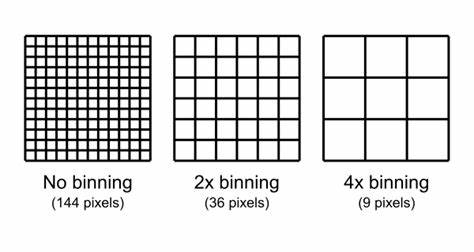
Figure 1: Binning principle
By combining pixel signals, binning can improve the signal-to-noise ratio (SNR). This helps cameras detect weaker signals. It can also improve image quality or reduce exposure times. The lower pixel count also reduces the image data made by the camera.
For example, 2x2 binning cuts data by a factor of 4.
This can help with data transfer, processing, and storage.
However, pixel-binned images have larger effective pixels. This may reduce the camera’s spatial resolution and detail in some optical setups. Consider this trade-off between sensitivity and resolution when you choose a scientific camera. It also matters when setting camera parameters like pixel size and binning mode.
Want to learn more about binning? Explore our complete guide to understand how binning works in scientific imaging and how it affects camera performance in microscopy and astronomy applications.


