

 2022/02/25
In low-light imaging, camera performance is often limited by how efficiently faint optical signals can be converted into usable image data. Quantum efficiency, or QE, is one of the most important specifications in this process because it reflects how effectively incoming photons are detected by the sensor. However, QE should not be viewed as a standalone number. In practice, its value depends on the imaging conditions, the wavelength range of interest, and the overall demands of the application.
This article focuses on how QE affects real low-light imaging performance and how to evaluate it more meaningfully in scientific camera selection.
Why QE Matters More in Low-Light Imaging?
Quantum efficiency describes the probability that photons reaching the sensor will actually be detected and converted into electrons. In scientific imaging, this matters because not every photon that arrives at the camera contributes to the final image. Some are reflected, scattered, or absorbed before detection can occur, which is why QE has a direct impact on usable signal.
Its importance becomes much greater in low-light imaging, where the available photon budget is limited and every detected photon counts more. In these conditions, a camera with higher QE can deliver stronger signal levels from the same scene, helping support better image quality and improved signal-to-noise performance. In some workflows, it can also help reduce the exposure time needed to achieve a usable image, which is especially valuable when imaging weak fluorescence, dynamic samples, or other photon-limited signals.
That said, QE is not equally critical in every application. In brighter imaging conditions, the benefit of higher QE may be less significant, and other camera characteristics may play a larger role in overall performance. For this reason, QE should be understood as a high-value specification in low-light imaging, rather than a universal indicator of which camera is best in every situation.
Why Peak QE Does Not Tell the Whole Story?
When evaluating a scientific camera for low-light imaging, it is tempting to focus on a single headline number such as peak QE. However, peak QE alone rarely tells the full story. Quantum efficiency is strongly wavelength-dependent, which means a sensor’s performance can vary significantly across the spectrum. As a result, the most meaningful question is not simply how high the peak QE is, but how well the sensor performs at the wavelengths that matter for the application.
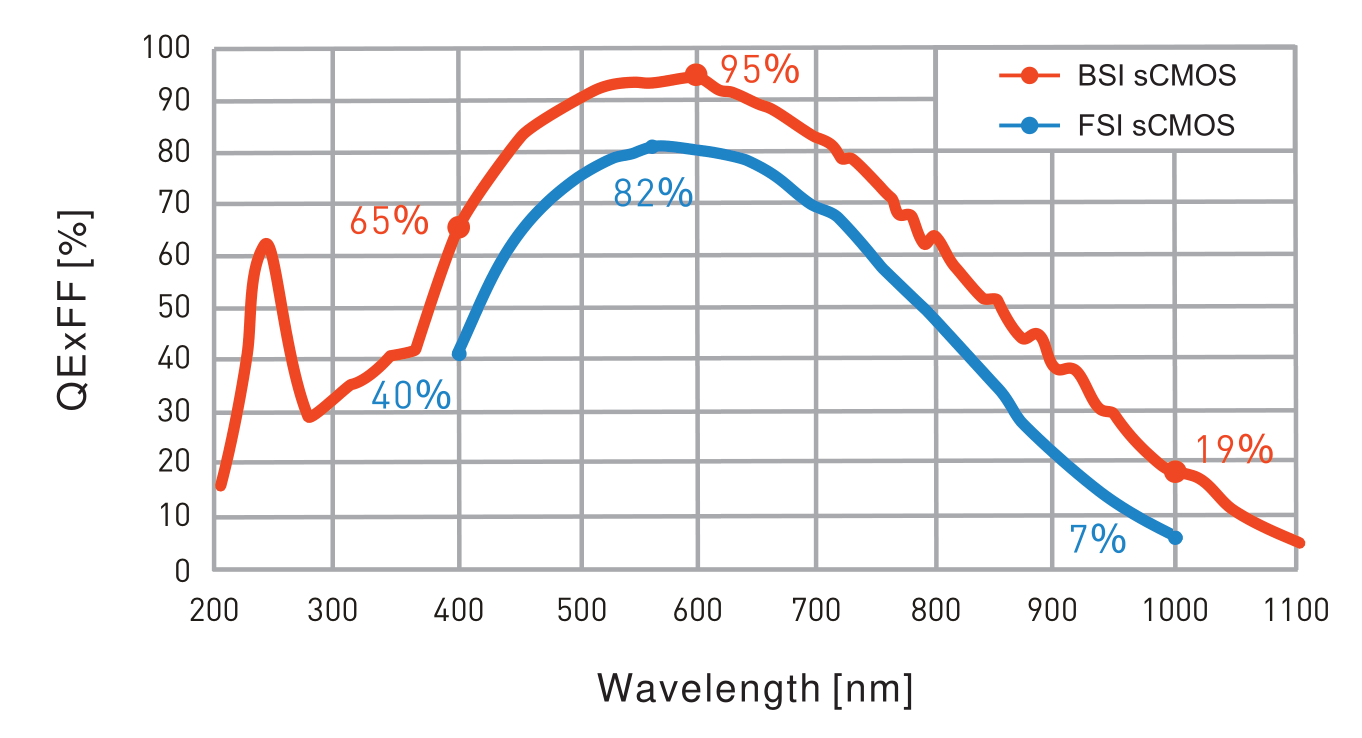
Example of a Quantum Efficiency curve.
Red: Back-side-illuminated CMOS.
Blue: Advanced Front-side-illuminated CMOS
This is why QE is typically shown as a curve rather than as a fixed value. A QE curve shows how efficiently the sensor converts photons into electrons at different wavelengths, and it provides far more practical information than one maximum percentage. Two cameras may appear similar if only their peak QE values are compared, yet behave quite differently at a specific fluorescence emission band, in the near-infrared region, or toward the short-wavelength end of the visible spectrum. For low-light imaging, that difference can directly affect usable signal and overall image quality.
In practical terms, a camera should be judged by its QE in the part of the spectrum where the real signal exists. A high peak QE at one wavelength does not necessarily mean stronger performance at another. This is especially important in scientific applications where the optical signal is concentrated in a narrow range rather than spread evenly across the visible band. In these cases, the full QE curve gives a much more realistic picture of expected performance than a single specification number.
For this reason, peak QE should be treated as a starting point rather than a conclusion. It can indicate the sensor’s general capability, but it should not be used on its own to compare cameras for demanding low-light tasks. A more reliable approach is to examine the QE curve in the relevant wavelength range and then interpret that result together with the rest of the camera’s performance characteristics.
How to Evaluate QE Alongside Read Noise, Dark Current, and Exposure Time?
Quantum efficiency is one of the most important specifications in low-light imaging, but it does not define low-light performance on its own. In practice, camera sensitivity depends not only on how efficiently photons are converted into signal, but also on how much noise is introduced during image acquisition. For that reason, QE should always be evaluated together with read noise, dark current, and exposure conditions.
QE and Read Noise
Read noise becomes especially important when signal levels are extremely weak. Even if a sensor has high QE, very faint signals can still be difficult to detect if too much noise is added during readout. In these situations, higher QE helps by converting more of the available photons into usable signal, but the final imaging result still depends on whether that signal can rise clearly above the read noise floor. For photon-limited imaging, QE and read noise should be considered together rather than separately.
QE and Dark Current
Dark current becomes more relevant as exposure time increases. During long exposures, thermally generated electrons can build up and reduce image clarity, especially in very dim imaging conditions. A camera with strong QE may capture more useful signal, but if dark current accumulates significantly during acquisition, the overall low-light advantage can be reduced. This is why QE should not be interpreted without considering exposure length and sensor noise behavior.
QE and Exposure Time
Exposure time is another key part of low-light imaging performance. One practical advantage of higher QE is that it can help a camera reach a usable signal level in less time, because more of the incoming photons are converted into measurable electrons. This can be valuable in applications where light is limited, where motion blur must be reduced, or where faster acquisition is needed. At the same time, the real benefit still depends on the broader imaging conditions rather than on QE alone.
Overall, the best low-light camera is not simply the one with the highest QE on paper, but the one that provides the right balance of photon detection efficiency, noise performance, and exposure flexibility for the application.
When Higher QE Is Worth the Cost?
A higher-QE camera can offer a real advantage in low-light imaging, but that advantage is not equally valuable in every application. In practice, the question is not simply whether one sensor achieves higher QE than another, but whether that gain leads to a meaningful improvement in the imaging workflow.
Why Some Sensors Achieve Higher QE
Different camera sensors can have very different QE values depending on their design and materials.
One major factor is sensor architecture, especially whether the sensor is front-side or back-side illuminated. In front-side illuminated sensors, incoming photons must pass through wiring and other structures before reaching the light-sensitive silicon, which can reduce photon collection efficiency. Advances such as microlenses have significantly improved the performance of front-illuminated designs, but back-illuminated sensors still generally offer higher peak QE because light reaches the photosensitive layer more directly. This higher performance, however, usually comes with greater manufacturing complexity and higher cost.
When the Higher-QE Advantage Matters
Quantum efficiency is not equally important in every imaging application.
In bright conditions, the practical benefit of higher QE may be limited. In low-light imaging, however, higher QE can improve signal-to-noise ratio and image quality, or help reduce exposure times for faster acquisition. For that reason, the value of a higher-QE sensor should be judged in the context of the application.
If the imaging task is strongly photon-limited, the performance gain may justify the additional cost. If it is not, a lower-cost camera with more moderate QE may still be the better overall choice.
Conclusion
QE remains one of the most important specifications in low-light imaging, but it should never be evaluated in isolation. A high peak QE value may look impressive, yet the more meaningful question is how well a camera performs at the wavelengths that matter for the application, and how that performance works alongside read noise, dark current, and exposure requirements. In practice, the best low-light camera is not simply the one with the highest QE on paper, but the one that delivers the right balance of sensitivity, noise performance, and system fit for the imaging task.
For users working with demanding low-light applications, taking a closer look at QE curves and overall sensor performance can lead to more reliable camera decisions. If you are evaluating scientific cameras for fluorescence, low-signal microscopy, or other photon-limited imaging workflows, Tucsen can help you compare the right options for your application.
Related article: For a broader introduction to QE fundamentals and datasheet interpretation, read Quantum Efficiency in Scientific Cameras: A Beginner’s Guide.
Tucsen Photonics Co., Ltd. All rights reserved. When citing, please acknowledge the source: www.tucsen.com


