

 2022/02/25
The sensor size as specified in inches (e.g. 1/2", 1”) can be a confusing specification. It does not in fact refer to the diagonal size of the camera sensor. The physical dimensions of the camera sensor can be found in the ‘Effective Area’ specification, or through multiplying the pixel size in the X dimensions by the number of pixels in X, and vice versa for Y.
1. Historical Origin: Optical Format and Vidicon Tube
The ‘Sensor Size’ specification is in fact an industry standard specification referring to the size of a tube lens that would be suited to the sensor. This convention originates from the Vidicon imaging tubes used in early video cameras. A tube’s nominal size (e.g., “1-inch tube”) described its outer glass diameter, not the usable imaging area. The actual sensitive region was typically about two-thirds of the tube’s outside diameter, which later evolved into today’s optical format terminology.
Therefore, even though modern digital sensors no longer use tubes, the industry continues using this legacy classification. As a result, a 1” ‘Sensor Size’ specification does not mean that the sensor diagonal will be exactly 1”. Further, as rounding is typically applied to the ‘Sensor Size’ specification, some error will be introduced.
2. Why Two Different Conversion Factors (>1/2" vs <1/2")
A table of common values and their corresponding approximate diagonal size in mm is included below. To calculate the approximate diagonal size of the sensor from the ‘Sensor Size’ specification, the formulas below must be used, though note that which formula to use depends on the value of the ‘Sensor Size’ specification for historical reasons.
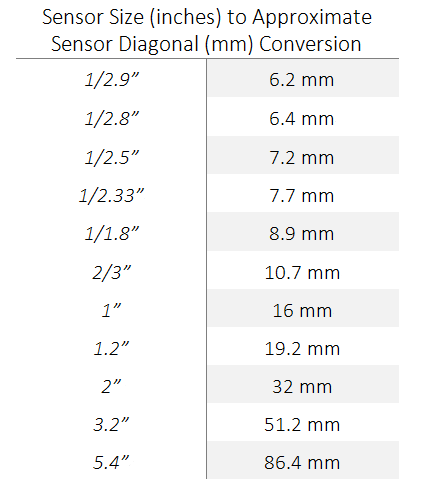
For sensor sizes above 1/2", the industry followed the conventions of larger Vidicon tubes. Their optical format ratio (tube diameter ÷ imaging diagonal) averaged around 1.5875, leading to:
Diagonal (mm)=[Sensor Size (inches) × 25.4] / 1.5875
For sensor sizes under 1/2", smaller tubes used a slightly different internal structure and imaging area ratio, closer to 1.4111, resulting in:
Diagonal (mm)=[Sensor Size (inches) × 25.4] / 1.4111
These two factors reflect the different geometric relationships between tube outside diameter and effective imaging area in different size classes of historical video tubes.
3. Sensor Size Calculation Formulae
For sensor sizes above 1/2":

For sensor sizes under 1/2":



