

 2025/12/20
The research group led by Prof. Yiming Li at Southern University of Science and Technology (SUSTech) has addressed key challenges in applying single-molecule localization microscopy (SMLM) to high-throughput super-resolution imaging by introducing LiteLoc, a scalable and lightweight deep-learning–based analysis framework. The work, entitled “Scalable and lightweight deep learning for efficient high accuracy single-molecule localization microscopy”, was published in the international journal Nature Communications.
LiteLoc Innovations
SMLM reconstructs super-resolution images by precisely localizing single fluorescent molecules across tens of thousands of stochastic blinking frames. The resulting data volumes impose stringent demands on computational efficiency, data throughput, and system scalability.
Designed around the core objectives of real-time performance, high localization accuracy, and high throughput, the LiteLoc framework overcomes several critical bottlenecks in high-throughput SMLM reconstruction:
By integrating neural representations with physics-based priors, PAMR demonstrates systematic improvements over traditional approaches:
Accelerated volumetric reconstruction: The reconstruction time for a single 3D volume (585 × 585 × 120 voxels) is reduced from 250 s to 28 s, corresponding to an approximate 10× increase in reconstruction speed.
Resolution enhancement beyond the diffraction limit: Using a hemispherical illumination system with 66 LEDs in combination with a 40×/0.95 NA objective, PAMR achieves half-pitch resolutions of 137 nm laterally and 550 nm axially, representing an approximately twofold improvement over the objective diffraction limit.
Robust performance under sparse-view conditions: High-fidelity reconstructions are maintained with up to 75% view reduction. When the number of illumination angles is reduced from 120 to 30, reconstruction quality remains stable, with SSIM values significantly exceeding those obtained using conventional FPT methods.
Dhyana 400BSI V3 sCMOS Camera Support for LiteLoc Innovations
High-fidelity signal acquisition and imaging stability are critical for the experimental validation of advanced computational microscopy algorithms. The Tucsen FL 9BW scientific camera provides key hardware capabilities that support the PAMR framework.
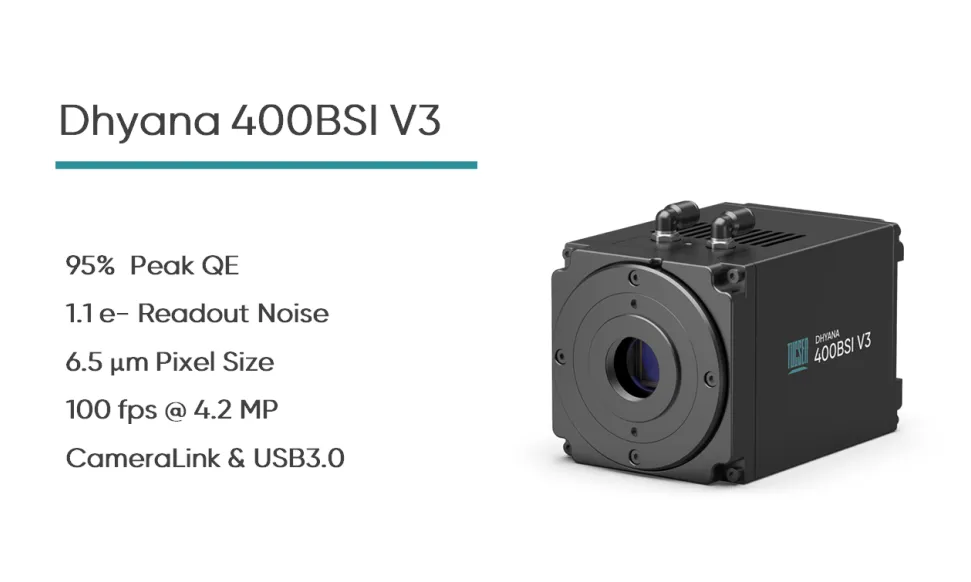
The LiteLoc SMLM system employs the Tucsen Dhyana 400BSI V3 sCMOS camera as its core imaging detector. The camera’s combination of high signal-to-noise performance and high-speed readout provides critical hardware support for achieving theoretical localization limits and enables closed-loop validation between algorithm development and experimental imaging.
1. Exceptional Signal-to-Noise Performance
With a quantum efficiency (QE) of up to 95%, the Dhyana 400BSI V3 maximizes the effective collection of single-molecule fluorescence signals. Its typical readout noise of 1.1 e⁻ (RMS) ensures robust signal-to-noise ratios under low-photon conditions, forming a solid foundation for LiteLoc to achieve localization accuracy close to theoretical limits.
2. High-Speed Data Output
The Dhyana 400BSI V3 delivers full-resolution imaging at up to 100 fps at 2048 (H) × 2048 (V), corresponding to a raw data generation rate of approximately 550 MB/s (11-bit). This throughput closely matches LiteLoc’s analysis rate of 567 MB/s, directly supporting the system’s high-throughput imaging objectives.
References
Fei, Y., Fu, S., Shi, W. et al. Scalable and lightweight deep learning for efficient high accuracy single-molecule localization microscopy. Nat Commun 16, 7217 (2025). https://doi.org/10.1038/s41467-025-62662-5
Copyright Notice: This article is intended to provide application references related to scientific cameras. Portions of the content are excerpted from relevant published research papers. All copyrights remain with the original authors. Please indicate the source when citing or reusing this material.


