

 2026/07/09
Scaling Neutral Atom Quantum Systems and the Emerging Imaging Bottleneck
Neutral atom systems are emerging as one of the most promising approaches in quantum computing.
In recent years, advances in optical tweezer arrays, Rydberg interactions, and programmable atom arrays have enabled rapid scaling, moving from tens of qubits to hundreds, with clear progress toward thousand-qubit systems.
As this scaling continues, a key bottleneck is shifting. In experimental systems, the role of scientific cameras is no longer defined primarily by extreme low-light sensitivity. Instead, the focus is moving toward high-fidelity quantum state readout.
Imaging is no longer just about detecting photons. It now requires accurate interpretation of quantum states.
Key Constraints in Quantum State Readout Imaging
During single-atom qubit readout, the number of usable photons is extremely limited. Under these conditions, system performance is no longer determined by a single specification, but by the entire imaging chain.
The challenge is to collect as many effective photons as possible under photon-starved conditions, while minimizing additional noise introduced during readout. At the same time, the system must maintain clear separation between bright and dark state distributions. These factors together define the final readout fidelity.
Aries 6504 Pro as a System-Level Solution
The Aries 6504 Pro is a single-photon-level sCMOS cameradesigned with a system-level perspective. Rather than optimizing for a single parameter, it is built around the full imaging chain in quantum experiments.
Its design focuses on three tightly coupled aspects:photon collection efficiency, system-level noise control, and precise timing and synchronization. This combination allows stable operation in low-light, high-noise, and high-dynamic-range environments typical of quantum research.
Signal and Noise Optimization for High-Fidelity Readout
Under extremely weak signal conditions, the key is not simply whether a signal can be detected, but whether signal and noise can be statistically separated.
The Aries 6504 Pro addresses this through a set of coordinated design choices:
l A 95% peak quantum efficiency (QE), enabled by back-illuminated (BSI) sCMOS architecture, maximizes photon collection from single-atom scattering events
l Ultra-low read noise (0.43 e⁻) supports single-photon sensitivity, widening the separation between bright and dark state distributions and improving threshold tolerance
l A 6.5 μm pixel design balances Nyquist sampling requirements in high-NA optical systems with strong per-pixel photon collection, maintaining both spatial resolution and signal efficiency
Comparison with Other Detection Technologies
Under equivalent photon flux and normalized detector area, signal-to-noise analysis reveals a clear trend.
Near the single-photon limit (approximately 1–2 photons), EMCCD retains an advantage due to its electron multiplication (EM gain) mechanism. However, as the photon count increases to around three photons or more, the Aries 6504 Pro achieves signal-to-noise performance comparable to leading BSI sCMOS sensors and exceeds that of EMCCD.
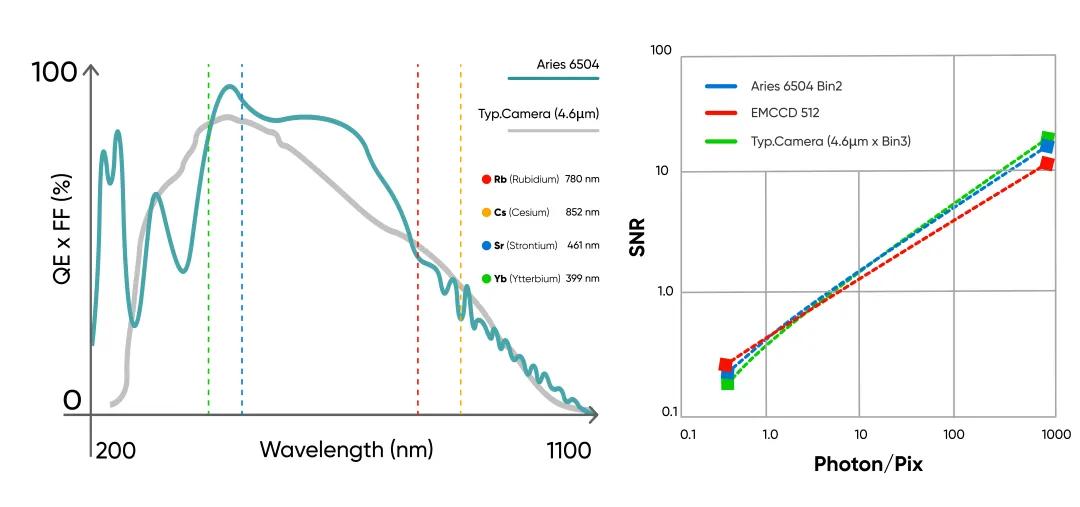
Figure 1:Comparison of detection performance under equal photon flux conditions
Real-Time Feedback Challenges in Scalable Systems
In practical experiments, signal strength is only part of the picture. Background non-uniformity, system noise drift, and fluorescence crosstalk between neighboring atoms all reduce readout fidelity. These effects place increasing demands on long-term stability and consistency.
The Aries 6504 Pro addresses this through hardware-software co-design:
PRNU < 0.3% and DSNU ~0.3 e⁻ improve pixel response uniformity
Deep cooling reduces dark current to 0.01 e⁻/pixel/s, limiting long-term drift
Real-time background correction converts part of the system error into correctable terms
This shifts the system from environment-dependent to self-correcting operation.
This approach allows the system to operate with less dependence on environmental stability and greater internal consistency.
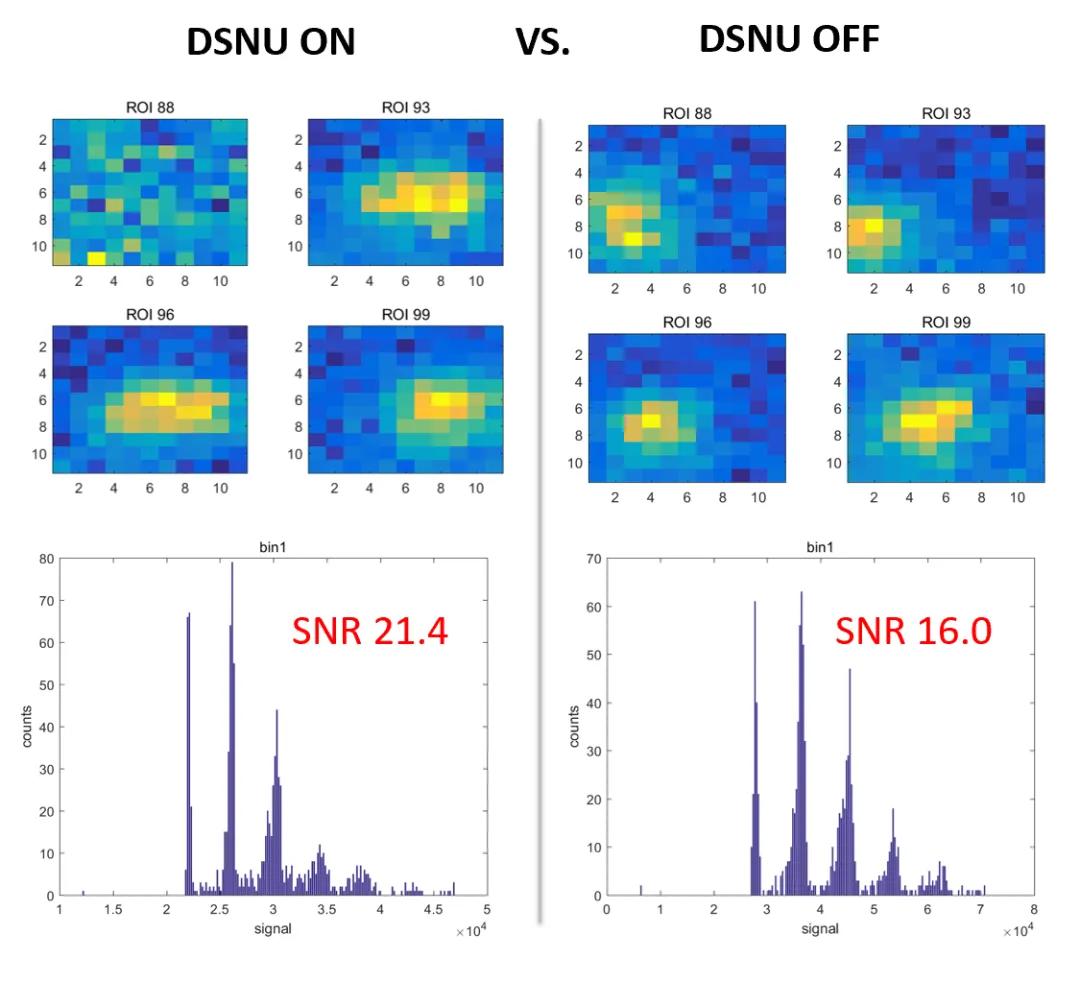
Figure 2:Actual measurement of DSNU background correction effect.
Early experimental results from single-atom detection using the Tucsen camera show that the DSNU algorithm can reduce fixed-mode noise interference and effectively improve the imaging signal-to-noise ratio.
Enabling System-Level Quantum Imaging
As neutral atom systems scale further, experiments increasingly rely on real-time feedback control. Processes such as atom loading verification, array rearrangement, and post-gate readout require fast interpretation and immediate feedback to the control system.
Within this workflow, the camera functions not just as an imaging device, but as a critical data input node.
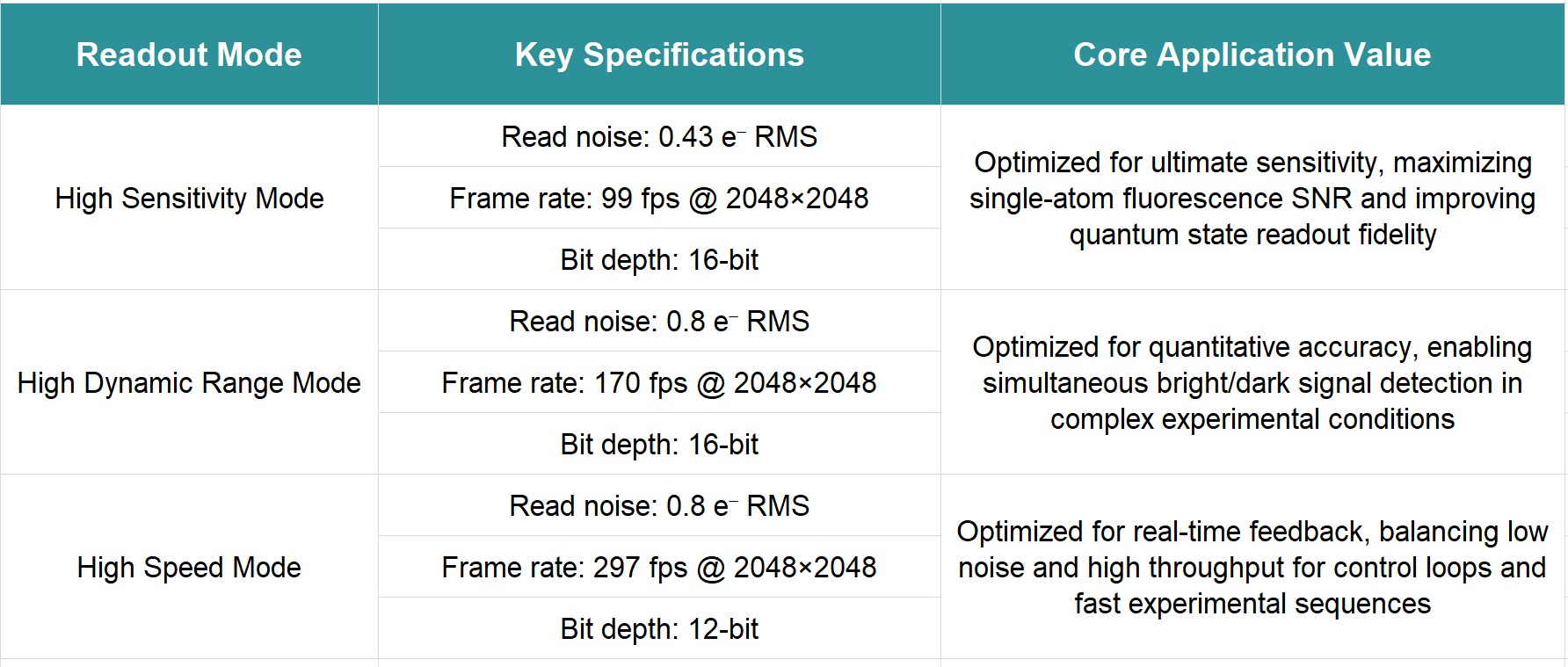
The Aries 6504 Pro supports this role with high-speed, low-noise imaging and ROI-based readout, reducing acquisition latency while maintaining accuracy. Hardware triggering and Global Reset synchronization ensure precise alignment with experimental timing. At the system level, support for CoaXPress and USB 3.2 allows flexibility between high-bandwidth operation and practical deployment.
The Aries 6504 Pro Different Read Modes:
Conclusion
Advances in quantum computing often depend less on stronger signals and more on more reliable interpretation of weak signals.
In neutral atom systems, performance is defined by how well the full imaging chain captures, resolves, and transfers information.
The Aries 6504 Pro is designed to meet this need. It is not only an imaging device, but a system-level solution for quantum state readout and experimental control.


