

 2025/09/04
In digital imaging, higher resolution does not always mean better images. Camera manufacturers market systems by megapixel count, while lens makers highlight resolving power. In practice, image quality depends on how well the lens and sensor work together. Nyquist sampling provides the framework for this balance. It ensures that the optical resolution of a lens and the digital resolution of a sensor are matched correctly. This article explains what Nyquist sampling is in imaging and how to align optical and camera resolution.
What Is Nyquist Sampling and the Nyquist Sampling Theorem?
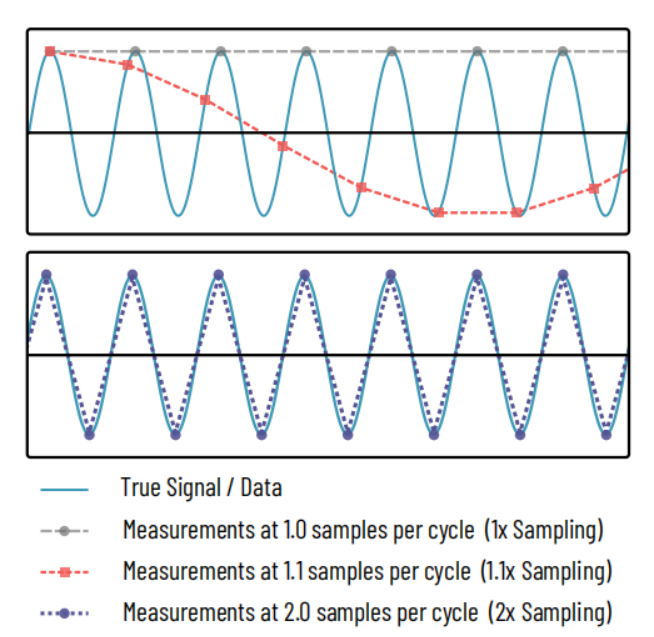
Figure 1: The Nyquist sampling theorem
Top: A sinusoidal signal (cyan) is measured, or sampled, at multiple points. The gray long-dashed line represents 1 measurement per cycle of the sinusoidal signal, capturing only signal peaks, completely hiding the true nature of the signal. The red finely dashed curve captures at 1.1 measurements per sample, revealing a sinusoid but misrepresenting its frequency. This is analogous to a Moiré pattern.
Bottom: Only when 2 samples are taken per cycle (purple dotted line) does the true nature of the signal begin to be captured.
The Nyquist sampling theorem is a principle common across signal processing in electronics, audio processing, imaging and other fields. The theorem makes clear that to reconstruct a given frequency in a signal, measurements must be made at least twice that frequency, shown in Figure 1. In the case of our optical resolution, this means that our object space pixel size must be at most half the smallest detail we are attempting to capture, or, in the case of a microscope, half the microscope’s resolution.
Orientation also matters. With a grid of square pixels, the 2× sampling factor only captures details that are perfectly aligned to the pixel grid, as shown in Figure 2. If you try to resolve structures at an angle to the grid, the effective pixel size becomes larger, up to √2 times at the diagonal. The sampling rate must therefore be 2√2 times the desired spatial frequency to capture details at 45° to the grid.
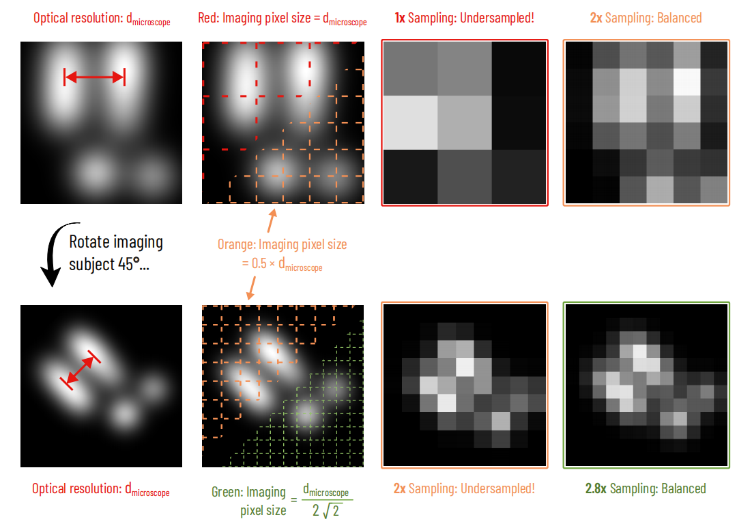
Figure 2: Nyquist sampling with square pixels: orientation matters
Consider the pixel size set to the optical resolution. Two neighboring point sources would each land on their own pixel. Although detected separately, nothing in the measurements shows that they are two separate peaks. Our definition of resolving is not met. A pixel in between is needed to capture the trough of the signal. This is achieved by at least doubling the spatial sampling rate, which means halving the object-space pixel size.
What to Watch For in Nyquist Sampling
Nyquist sampling works only when you can separate two types of resolution.
● Optical resolution is determined by the lens. It reflects the lens's ability to reproduce fine detail. Lens quality, aperture, and diffraction set this limit. The modulation transfer function (MTF) measures how well a lens transmits contrast at different spatial frequencies.
● Camera resolution is determined by the sensor. It depends on pixel size, pixel pitch, and overall sensor dimensions. The pixel pitch of a CMOS camera directly defines its Nyquist frequency, which sets the maximum detail the sensor can capture.
When these two are not aligned, problems arise. A lens that exceeds the resolving power of the sensor is effectively "wasted", since the sensor cannot capture all the details. Conversely, a high-resolution sensor paired with a low-quality lens results in images that do not improve despite more megapixels.
How to Balance Optical and Camera Resolution
Balancing optics and sensors means matching the Nyquist frequency of the sensor with the optical cutoff frequency of the lens.
● The Nyquist frequency of a camera sensor is calculated as 1 / (2 × pixel pitch). This defines the highest spatial frequency the sensor can sample without aliasing.
● The optical cutoff frequency depends on lens characteristics and diffraction.
For best results, the sensor’s Nyquist frequency should align with or slightly exceed the lens’s resolving ability. In practice, a good rule of thumb is to ensure the pixel pitch is about half the smallest resolvable feature size of the lens.
When the two are not aligned, problems arise. A lens that exceeds the resolution of the sensor is effectively wasted, because the sensor cannot capture all the detail. Conversely, a high-resolution sensor paired with a low-quality lens produces no improvement, despite having more megapixels.
How to Calculate Nyquist Frequency
The Nyquist frequency of a camera sensor is calculated as 1 / (2 × pixel pitch). This defines the highest spatial frequency the sensor can sample without aliasing. The optical cutoff frequency depends on the lens characteristics and diffraction.
Matching Nyquist Sampling with Camera Resolution
Balancing optics and sensors means matching the Nyquist frequency of the sensor with the optical cutoff frequency of the lens. For best results, the sensor's Nyquist frequency should align with, or slightly exceed, the lens's resolving ability.
A good rule of thumb is to keep the pixel pitch at about half the smallest feature size the lens can resolve. For example, if a lens resolves details down to 4 micrometers, a sensor with pixel sizes of about 2 micrometers balances the system well.
However, reducing the object-space pixel size reduces light collection. A common approach sets the object-space pixel size, multiplied by a Nyquist factor, equal to the optical resolution. This quantity is called camera resolution. A system matches Nyquist when:
Camera resolution = Optical resolution
Where the camera resolution is given by:

The recommended Nyquist factor is often 2.3, not 2. Camera pixels are square and arranged on a 2-D grid. If the features you want to resolve lie at any angle other than a multiple of 90° to the grid, the effective pixel size becomes larger, up to √2 ≈ 1.41 times at 45°, as shown in Figure 2 (bottom). The criterion in all orientations would be 2√2 ≈ 2.82. Because of the trade-off between resolution and light collection, a compromise value of 2.3 is recommended.
The Role of Nyquist Sampling: Common Applications
Nyquist sampling is the gatekeeper of image fidelity. When sampling falls below the Nyquist limit, problems appear.
● Undersampling causes aliasing. This leads to false details, jagged edges, or Moiré patterns.
● Oversampling captures more data than the optics can deliver. It produces larger files and higher processing demands with no visible benefit.
Correct sampling keeps images sharp and true to reality. In practice, systems may deliberately oversample or undersample depending on the application.
Undersampling uses a larger object-space pixel size than Nyquist demands. It sacrifices fine detail, but provides advantages.
● Sensitivity improves, because larger pixels collect more light and raise the signal-to-noise ratio in low-light imaging.
● Speed improves, because fewer pixels reduce readout time and enable faster acquisition.
● Data efficiency improves, because smaller file sizes suit bandwidth-limited systems.
Example: In calcium or voltage imaging, signals are often averaged over regions of interest. Undersampling improves light collection without compromising the scientific outcome.
Oversampling uses smaller imaging pixels than Nyquist demands. It is useful when resolving fine details or recovering information beyond the diffraction limit matters.
● It enables digital zoom with less quality loss.
● It improves post-processing, including deconvolution, denoising, and super-resolution.
● It reduces visible aliasing when images are later downsampled.
Example: In microscopy, a high-resolution sCMOS camera may oversample cellular structures so that computational algorithms can extract fine details beyond the diffraction limit.
Nyquist sampling is applied across several disciplines
● Microscopy: microscopy cameras must sample at least twice the smallest detail resolvable by the objective lens. Pixel size must align with the diffraction-limited resolution of the microscope objective. Modern laboratories often prefer sCMOS cameras, which balance sensitivity, dynamic range, and fine pixel structures for high-performance biological imaging.

● Astronomy: Telescopes capture faint, distant signals. Matching sensors with telescope optics ensures maximum detail without introducing artifacts.
● Photography: Pairing high-megapixel sensors with lenses that cannot resolve equally fine details produces little visible improvement. Professional photographers balance lenses and cameras to avoid wasted resolution.
● Machine Vision: In quality control and industrial inspection, missing small features due to undersampling can allow defective parts to go undetected. Oversampling may be used deliberately for digital zoom or enhanced processing.
Common Misconceptions
1. More megapixels always mean sharper images. Sharpness depends on the lens's resolving power and on whether the sensor samples appropriately.
2. Any good lens works with any high-resolution sensor. A poor match between lens resolution and pixel pitch limits performance.
3. Nyquist sampling only applies to signal processing, not imaging. Digital imaging is fundamentally a sampling process. Nyquist is as relevant here as in audio or communications.
Conclusion
Nyquist sampling is more than a mathematical idea. It is the principle that lets optical and digital resolution work together. By aligning the resolving power of lenses with the sampling capabilities of sensors, imaging systems achieve maximum clarity without artifacts or wasted capacity.
Balancing optical and camera resolution matters more than chasing megapixels. Unsure how to match lens, sensor, and pixel pitch for your setup? Explore our sCMOS cameras, or ask our imaging engineers for camera selection guidance tailored to your application.
FAQs
What happens if Nyquist sampling isn’t satisfied in a camera?
When the sampling rate falls below the Nyquist limit, the sensor cannot represent fine details correctly. This results in aliasing, which appears as jagged edges, moiré patterns, or false textures that do not exist in the real scene.
How does pixel size affect Nyquist sampling?
Smaller pixels increase the Nyquist frequency, meaning the sensor can theoretically resolve finer details. But if the lens cannot deliver that level of resolution, the extra pixels add little value and may increase noise.
Is Nyquist sampling different for monochrome vs. color sensors?
Yes. In a monochrome sensor, every pixel samples luminance directly, so the effective Nyquist frequency matches the pixel pitch. In a color sensor with a Bayer filter, each color channel is undersampled, so the effective resolution after demosaicing is slightly lower.
Tucsen Photonics Co., Ltd. All rights reserved. When citing, please acknowledge the source: www.tucsen.com


