

 2026/07/12
Research Background and Challenges
A recent study led by researchers at Shandong University focuses on coronal cavities—key solar coronal structures linked to prominences and involved in coronal heating and CME initiation. However, their intrinsically low brightness, large dynamic range, and complex multi-thermal nature have long limited high-precision spectroscopic observations, particularly for quantitative analysis of nonthermal line broadening and turbulence. The study addresses major technical challenges, including detecting extremely faint signals against strong background emission, achieving high dynamic range imaging, ensuring precise multi-wavelength temporal synchronization, and maintaining high signal-to-noise ratio and detector linearity for accurate nonthermal velocity measurements.
Key Scientific Findings on Coronal Cavities
The results show that coronal cavities exhibit clear temperature-dependent characteristics across different spectral lines. The cavity structure is prominently visible in the Fe XIV 5303 Å line (~2 MK) but nearly absent in the Fe X 6374 Å line (~1 MK), indicating that these structures are primarily associated with higher-temperature coronal plasma. Doppler velocity analysis further reveals a nested ring-like pattern of alternating redshifts and blueshifts, with spatial scales distinct from typical streamer structures. The cavity core region, located directly above the prominence, shows the highest Doppler velocities and the strongest nonthermal line broadening.
Crucially, this study provides the first quantitative evidence that nonthermal velocities within coronal cavities are significantly higher than in surrounding regions, indicating enhanced turbulence and wave activity. These findings support continuous mass and energy exchange between prominence material and hot coronal plasma, likely driven by localized magnetic reconnection and energy dissipation. Together, the results offer new observational constraints on coronal magnetic structures and improve our understanding of energy transport and small-scale turbulence in the solar corona.
Note: Nonthermal velocity distribution map of a coronal cavity. This study presents the first quantitative measurement of nonthermal velocities within a coronal cavity, confirming the presence of strong turbulence inside the structure. The Dhyana 95 camera, as the core imaging component of the SICG system, ensures high-precision data acquisition.
High-Precision Spectral Imaging with Dhyana 95
Coronal spectral imaging operates under conditions where extremely faint signals must be detected against intense background emission, resulting in an exceptionally large dynamic range. At the same time, multi-wavelength image acquisition imposes additional demands on detector performance and precise timing synchronization. The Tucsen Dhyana 95 camera provides a critical foundation for weak-signal spectral sampling and high-precision data acquisition in coronagraph systems.
① Ultra-high sensitivity and low noise for faint signal detection
With a peak quantum efficiency of 95% and ultra-low read noise of 1.6 e⁻, the camera effectively captures subtle spectral details, ensuring accurate quantification of turbulence and nonthermal velocities.
② Wide dynamic range for quantitative spectral fidelity
A full well capacity of 100 ke⁻ and a dynamic range of up to 90 dB enable simultaneous imaging of strong background emission and extremely weak coronal signals, preventing saturation and signal distortion.
③ Precise timing control for multi-wavelength acquisition
The electronic shutter and hardware triggering mechanism enable tight synchronization with the SICG filter wheel during wavelength switching, supporting stable multi-point, time-sequenced spectral sampling and ensuring reliable spectral fitting.
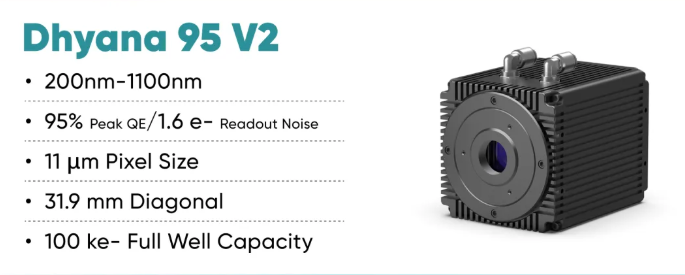
④ Efficient cooling system for stable linear response
A dual cooling design combining air and water cooling maintains a stable detector temperature, minimizing thermal drift and response deviation, and ensuring long-term linearity and consistency in extended observations.
References
Chenxi Huangfu et al. 2025, The Astrophysical Journal Letters, 995, L71
DOI: 10.3847/2041-8213/ae2a35
Copyright Notice
This article is intended to provide application references related to scientific cameras. Portions of the content are adapted from published research. All copyrights remain with the original authors. Please cite the original source when reusing this material.


