

 2026/07/23
Research Background and Challenges
A recent study explores how to image fast-evolving nanoscale processes in materials science and life sciences using coherent X-ray diffraction imaging (CDI).
CDI is a powerful lensless imaging technique that enables non-destructive imaging at nanometer resolution. It is well suited for observing microscopic dynamics, but capturing both high spatial resolution and real-time changes remains challenging.
Existing approaches face clear trade-offs. Ptychography delivers high image quality but relies on scanning, which makes it difficult to capture fast dynamics. Single-pattern CDI enables faster acquisition but often struggles with image stability and reconstruction accuracy.
Researchers have attempted to improve dynamic CDI by adding static reference regions or using temporal correlations between frames. However, these methods either increase experimental complexity or become unreliable when the sample changes rapidly. As a result, there is a strong need for a more robust and efficient imaging approach that can handle dynamic systems without sacrificing resolution.
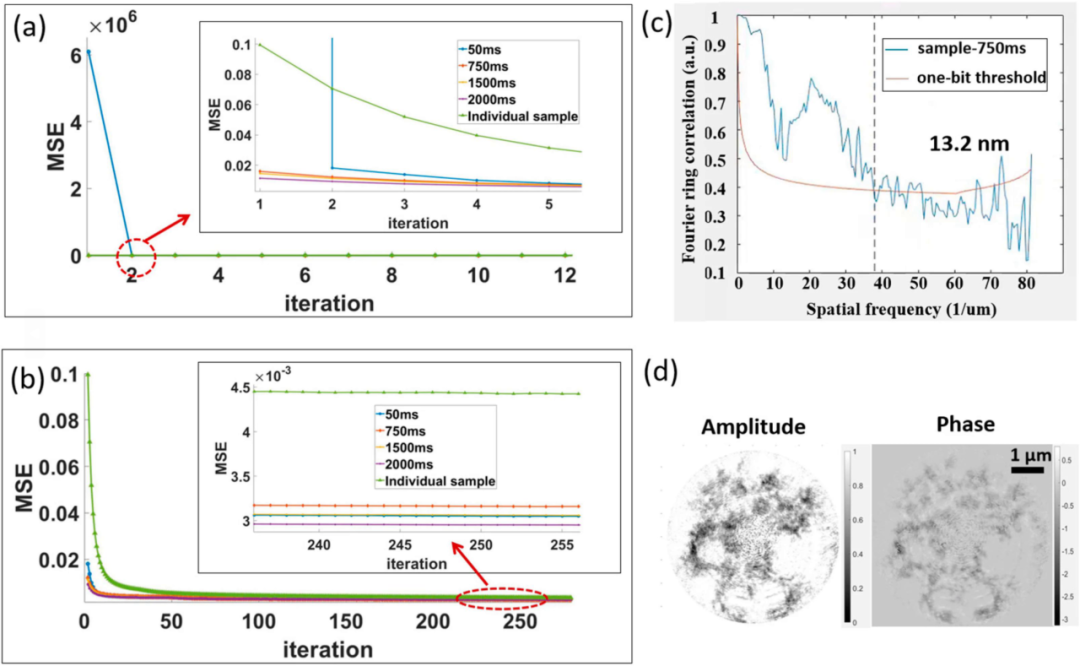
Note: Key Performance Results of dynCDI
Key Scientific Findings and Imaging Performance
To overcome these limitations, the team developed a new dynamic CDI method based on Fresnel zone-plate optics, combining spatial and temporal constraints with probe optimization.
-
Achieved 13.2 nm spatial resolution, enabling detailed visualization of nanoscale structures.
-
Reached a temporal resolution of 20 Hz, allowing real-time tracking of dynamic processes.
-
Improved reconstruction stability by introducing a modulus-enforced probe constraint.
-
Enhanced image consistency by leveraging temporal correlations in low-frequency sample information.
-
Used a static region constraint to further stabilize reconstruction without complex system modifications.
The reconstructed results show strong agreement with ptychography, confirming both accuracy and reliability.
For example, dynamic structural changes in nanoscale samples can be tracked frame by frame with high clarity, providing direct insight into material behavior that was previously difficult to observe.
Why Choose Dhyana XV95 for this dynCDI Experiments?
Dynamic CDI requires continuous acquisition of X-ray diffraction patterns with large intensity variations over extended periods. The system typically operates in a vacuum, vibration-isolated optical setup, where stability and data accuracy are critical. Data quality directly impacts the performance of multi-constraint reconstruction algorithms.
The Dhyana XV95 is designed to meet these demanding requirements across the entire workflow, from signal detection to long-term system stability:
High sensitivity and low noise
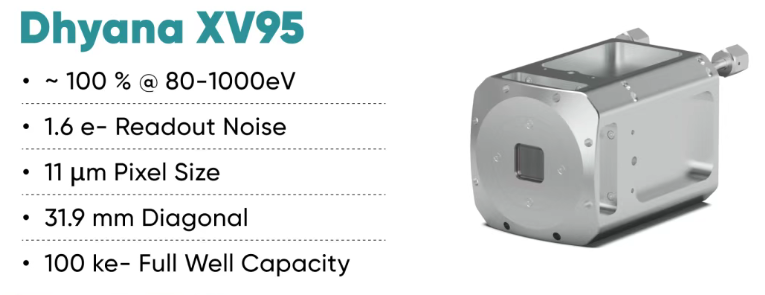
Delivers near 100% quantum efficiency in the 80–1000 eV range (EUV to soft X-ray), with read noise as low as 1.6 e⁻, enabling reliable detection of weak diffraction signals while minimizing reconstruction artifacts.
Wide dynamic range
With a 100 ke⁻ full well capacity and 90 dB dynamic range, the camera captures both intense central spots and weak peripheral diffraction signals in a single exposure, ensuring accurate quantitative analysis.
Low-latency continuous readout
Uses an electronic shutter to support seamless, low-latency acquisition, maintaining stable operation at 20 Hz to meet dynamic imaging requirements.
Vacuum compatibility
Fully compatible with high-vacuum environments down to 10⁻⁵ Pa, ensuring stable operation in soft X-ray beamlines without outgassing or mechanical deformation.
Radiation robustness
Built with radiation-tolerant sensors and packaging materials, allowing long-term operation under X-ray exposure with high reliability and extended system lifetime.
These capabilities make the Dhyana XV95 a reliable detection solution for high-resolution dynamic CDI, supporting accurate and stable imaging in demanding experimental conditions.
References
Zhang, Y.; Xu, Z.; Zhao, B.; Zhang, X.; Li, R.; Chen, S.; Wu, S. Dynamic Coherent Diffractive Imaging with Modulus Enforced Probe and Low Spatial Frequency Constraints. Sensors 2025, 25, 2323. https://doi.org/10.3390/s25072323
Copyright Notice
This article is intended to provide application references related to scientific cameras. Portions of the content are adapted from published research. All copyrights remain with the original authors. Please cite the original source when reusing this material


