

 2026/07/21
Astronomical imaging is the primary way humans observe and quantify the universe. From detecting faint deep-sky objects to capturing fast transient events, the performance of imaging detectors directly determines what can be seen, measured, and understood.
Modern astronomical imaging typically involves integrating telescopes, detectors, cooling systems, and data processing pipelines. Key applications include deep-sky surveys, time-domain astronomy, adaptive optics, exoplanet detection, and near-Earth object monitoring. Each of these applications places different demands on sensitivity, speed, field of view, and stability.
Over the past several decades, advances in detector technology have fundamentally reshaped these capabilities.
The evolution of astronomical imaging
CCD technology established the foundation of modern astronomy
Since the 1970s, CCD sensors have replaced photographic plates and early electronic detectors, introducing a fully digital approach to astronomical observation.
With high quantum efficiency, strong linearity, and stable low-light performance, CCDs enabled precise photometry, astrometry, and spectroscopy. This allowed astronomers to measure brightness variations, track object motion, and analyze physical properties with unprecedented accuracy.
CCD technology effectively transformed astronomy into a quantitative, data-driven science and remains widely used in applications requiring ultra-low noise and long exposure stability.
EMCCD technology enabled extreme low-light and adaptive optics applications
As telescope apertures increased, atmospheric turbulence became the primary limitation for ground-based observations. Adaptive optics systems were developed to correct these distortions in real time.
Such systems require detectors with extremely demanding performance characteristics, including single-photon sensitivity, near-zero read noise, and high frame rates.
EMCCD technology addressed these needs through on-chip electron multiplication, enabling reliable signal detection under extremely low light. It became a critical tool for wavefront sensing, lucky imaging, and other high-speed, low-light applications.
sCMOS technology supports high-throughput and time-domain astronomy
In recent years, astronomy has shifted toward observing dynamic and transient phenomena, such as supernovae, fast radio bursts, and space debris tracking.
These applications require detectors that can simultaneously deliver:
- Large imaging areas for wide-field surveys
- High frame rates for temporal resolution
- Low read noise for weak signal detection
- Wide dynamic range for complex scenes
sCMOS technology provides a balanced solution across all these dimensions. Rather than replacing CCD or EMCCD, it complements them by enabling new observation modes that were previously impractical.
A decade of Tucsen product evolution reflects four core imaging capabilities
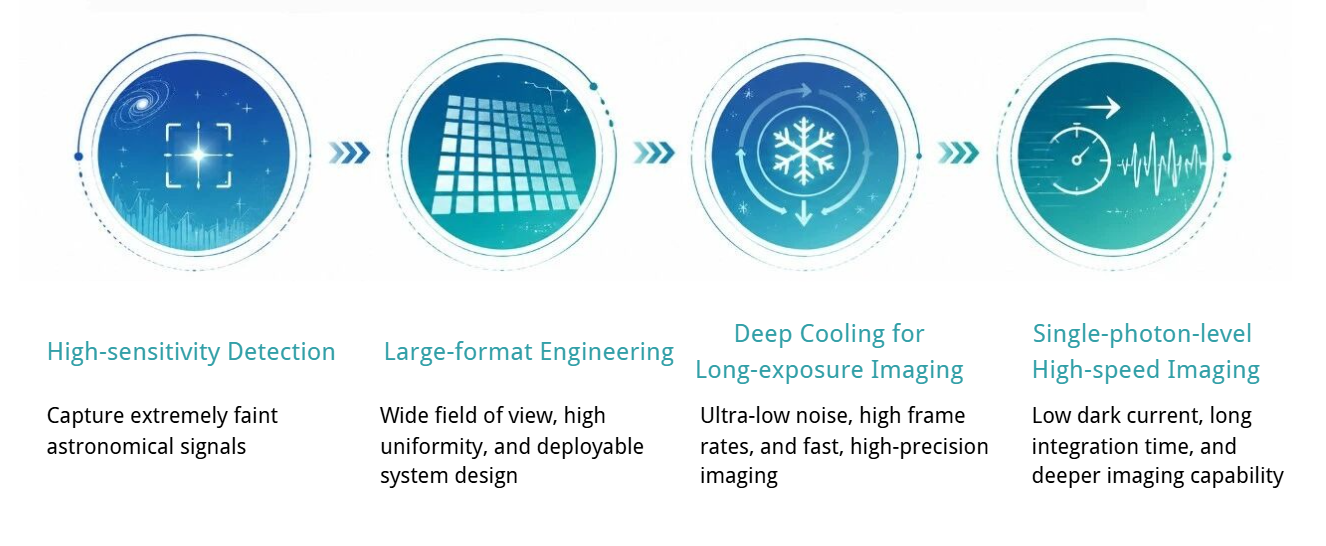
Over the past ten years, the development of advanced astronomical cameras has followed a clear progression—not just in specifications, but in system-level capability.
High sensitivity established the ability to detect faint signals
Sensitivity is the first requirement in astronomy. Without sufficient signal detection capability, no further analysis is possible.
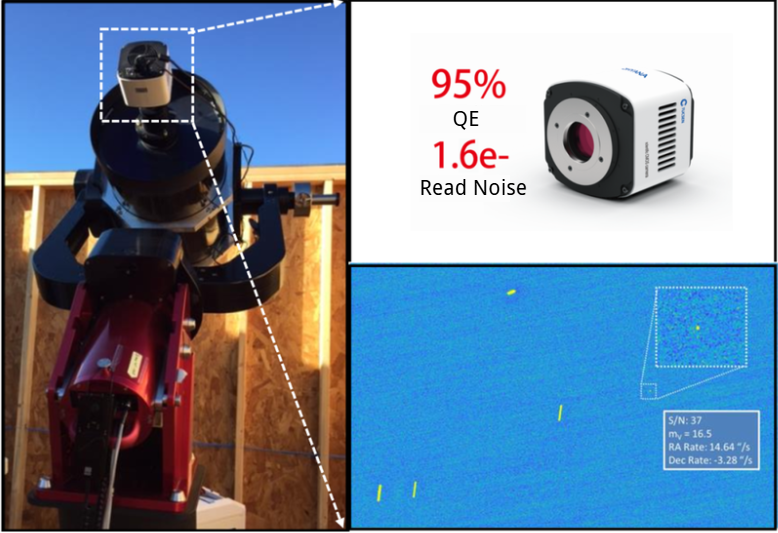
The Dhyana 95, a back-illuminated sCMOS camera, delivers 95% quantum efficiency and 1.6 e⁻ read noise, achieving near-EMCCD-level performance in many low-light scenarios. It has been successfully applied in telescope-based observations such as near-Earth object detection.
This level of performance ensures that extremely weak signals can be reliably captured, forming the baseline for modern astronomical imaging.
Large-format engineering enabled wide-field and stable system deployment
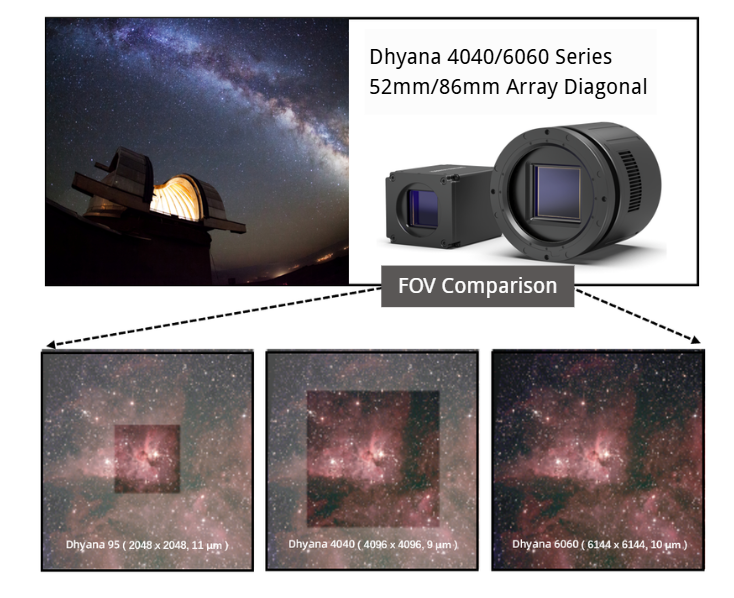
As survey astronomy expands, capturing larger areas of the sky efficiently has become increasingly important. However, large-format sensors introduce significant engineering challenges.
These include maintaining sensor flatness, controlling DSNU and PRNU, ensuring long-term operational stability, and coordinating multiple systems in synchronized observations.
The Dhyana 4040 and 6060 series were developed to address these challenges. Designed for professional observatories, they support large-aperture telescopes and enable stable, long-duration operation in complex environments.
This represents a shift from component-level performance to system-level reliability.
Deep cooling and long exposure made faint deep-space imaging practical
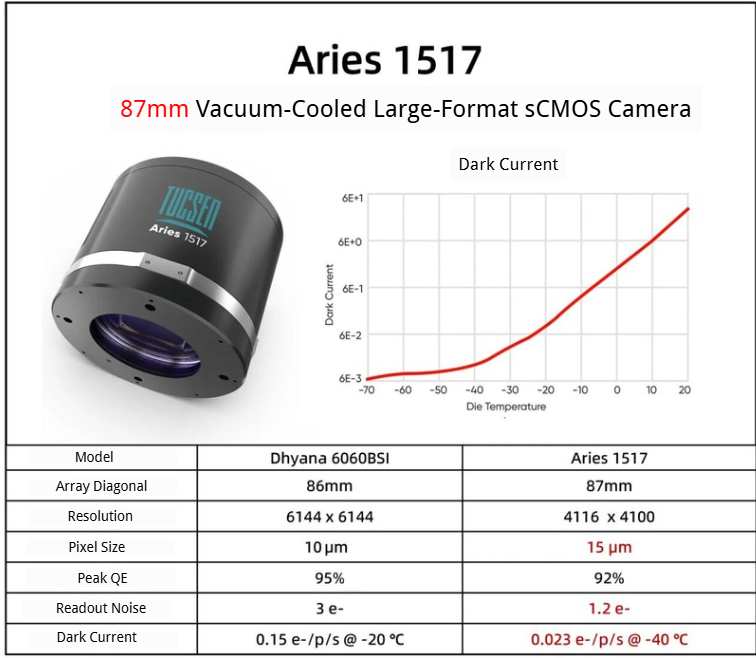
Observing distant deep-sky objects often requires exposure times ranging from several minutes to tens of minutes. During these long integrations, dark current becomes a critical limiting factor.
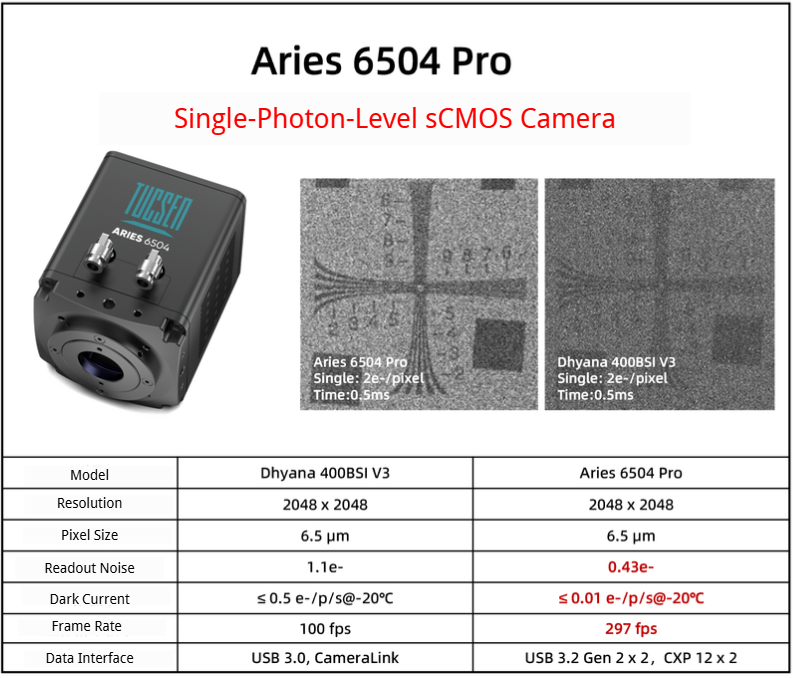
The Aries 1517 introduces a vacuum-sealed deep cooling architecture combined with a large 87 mm sensor format. At -40°C, it achieves a dark current of 0.023 e⁻/pixel/s, significantly reducing noise during long exposures.
This capability enables more stable and accurate detection of extremely faint astronomical targets, particularly in deep-field survey applications.
High-speed single-photon detection enables precise observation of dynamic events
Modern astronomy increasingly focuses on fast-changing phenomena. Applications such as exoplanet transits, adaptive optics, and lucky imaging require both high temporal resolution and extreme sensitivity.
The Aries 6504 Pro combines:
- 0.43 e⁻ RMS read noise
- 297 fps full-resolution imaging
- 0.01 e⁻/pixel/s dark current at -20°C
This allows it to detect extremely weak signals while maintaining high-speed acquisition, supporting precise measurement of rapidly evolving events.
In practical applications, it demonstrates performance comparable to EMCCD systems while offering broader operational flexibility.
From individual specifications to integrated imaging capability
The evolution of astronomical cameras over the past decade is best understood as a transition from isolated performance improvements to integrated system capability.
Progress has followed a clear path:
- From detecting faint signals
- To capturing wider fields
- To reaching deeper into space
- To resolving faster and more complex phenomena
These capabilities are interconnected rather than independent. Together, they form a complete imaging framework that supports modern astronomical research.
Importantly, this progression represents an expansion of technological options rather than a replacement cycle. CCD, EMCCD, and sCMOS technologies each continue to play important roles, depending on the specific requirements of the application.
If you are evaluating which technology or camera is best suited for your application, contact our engineering team to help you identify the most effective solution.


