

 2026/10/23
Highlights
● TU Delft researchers use the Aries 6504 Pro to investigate protein–DNA dynamics through single-molecule fluorescence imaging.
● High quantum efficiency at 488 nm, 532 nm and 640 nm supports fluorescence signal detection across the team's excitation wavelengths.
● Low read noise and fast acquisition help capture rapid molecular events on millisecond timescales.
“The Aries 6504 has great QE at our wavelengths and is extremely fast: perfect for our millisecond-scale imaging of protein-DNA dynamics.”
—Theo Koenig, TU Delft, Netherlands
Group Research Aims
Prof. Cees Dekker's group investigates how individual proteins interact with and move along DNA. By observing these processes at the single-molecule level, Theo Koenig aims to reveal dynamic behaviours that can be obscured in conventional measurements, providing a clearer understanding of the molecular mechanisms governing protein–DNA interactions of chromosome motor proteins.
How Is the Aries 6504 Pro Used in the Experiment?
The group’s experiments use tethered DNA molecules with fluorescently labelled proteins, allowing changes in protein position and behaviour to be monitored using Förster resonance energy transfer (FRET) and intensity based single-molecule fluorescence.
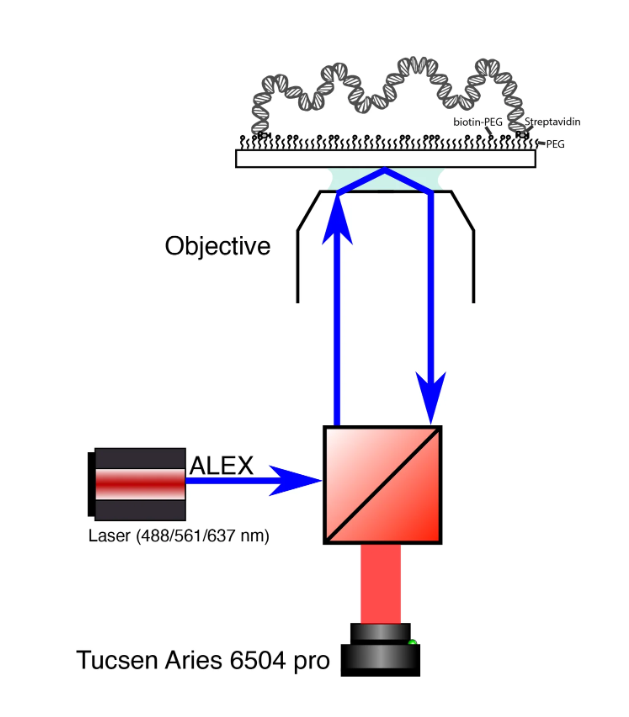
The system incorporates 488 nm, 532 nm and 640 nm excitation wavelengths, creating a demanding imaging environment in which efficient photon detection and rapid acquisition are essential for resolving molecular events occurring on millisecond timescales.
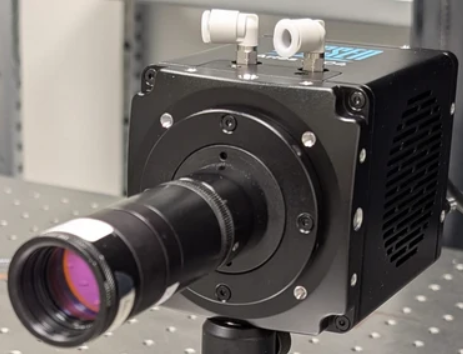
The team selected Tucsen's Aries 6504 Pro for its combination of high quantum efficiency at their fluorescence wavelengths and the acquisition speed needed to follow extremely rapid molecular dynamics.
What Has the TU Delft Team Said About the Aries 6504 Pro?
“For our experiments, exposures have to be short enough to capture fast events, while still collecting sufficient signal for reliable analysis. We really like the Aries 6504 for this. Tucsen were also quick to provide us with a solution and provide great remote support during setup.”
– Theo Koenig, Dekker lab, TU Delft
Why choose Aries 6504 Pro
The Aries 6504 Pro uses the GSENSE6504BSI sensor which enables one of the highest sensitivity sCMOS cameras on the market.
● 95% Peak QE
● Up to 300 fps @ 0.8 e- Read Noise, or
● Up to 100 fps @ 0.4 e- Read Noise
● 4 Million Pixels
● 6.5 Micron Pixels
● USB 3.2Gen2x2 & CXP12
FAQ
1. What applications is the Aries 6504 Pro designed for?
The Aries 6504 Pro is designed for low-light and high-speed scientific imaging, including fluorescence microscopy, single-molecule imaging and life science research. Its 0.43 e⁻ RMS read noise, 297 fps frame rate, and low dark current support demanding imaging applications requiring both sensitivity and speed.
2. How fast can the Aries 6504 Pro acquire images?
The Aries 6504 Pro delivers up to 297 fps at full 4.2 MP resolution in Speed mode, with read noise as low as 0.8 e⁻. For application-specific performance requirements, please contact our technical team.
Recommended Reading
Application Advantages of the Aries 6504 sCMOS Camera
Explore how the Aries 6504 supports demanding scientific imaging applications with its high sensitivity and fast acquisition capabilities.
Learn more about the camera's key specifications and available performance options.


