

 2026/10/23
Highlights
● Faint-signal imaging: Dhyana 95V2 served as a key detection device in the balloon-borne white-light coronagraph (BBWLC) experiment.
● A new observation milestone: The BBWLC captured white-light coronal data at 1.08–1.50 solar radii from an altitude of approximately 30 km.
● Advancing solar astronomy: The experiment demonstrated China's capability to develop and operate a balloon-borne solar coronagraph.
Why is inner-corona imaging challenging?
The solar corona is much fainter than the solar disk. Capturing its structures requires effective stray-light suppression and a sensitive detector that can distinguish weak signals from background light.
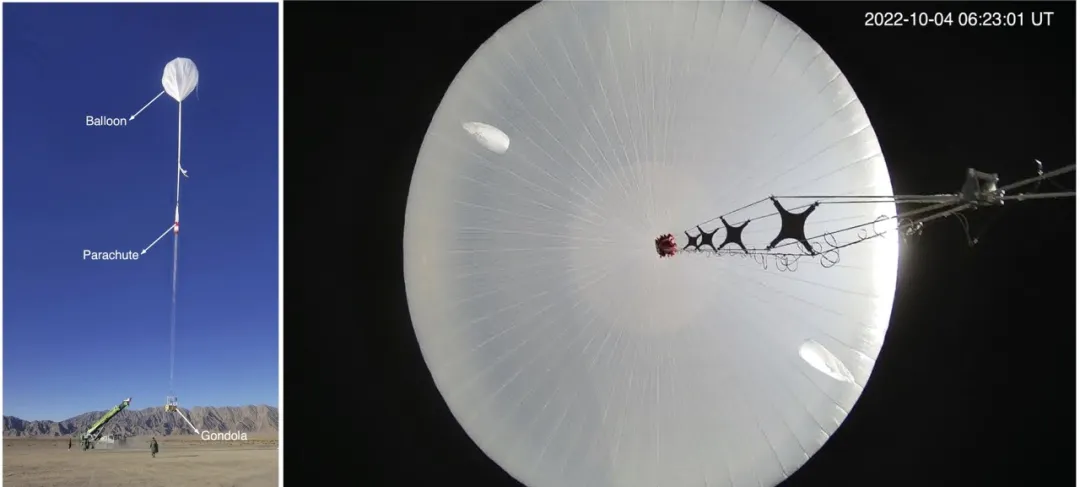
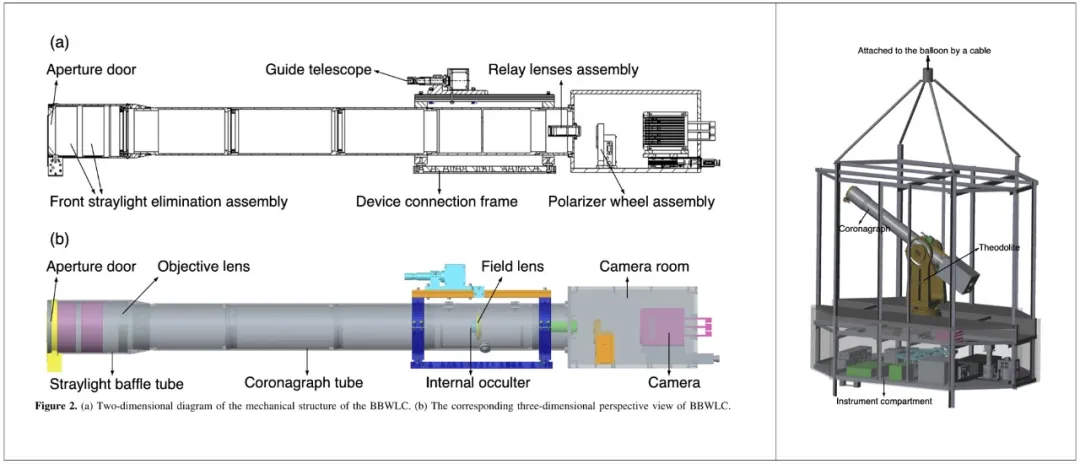
To meet this challenge, researchers developed a 50 mm balloon-borne white-light coronagraph (BBWLC) to observe the corona from 1.08 to 1.50 solar radii from the Sun's center.
How did Dhyana 95V2 support the experiment?
Dhyana 95V2 served as a key imaging detector in the BBWLC experiment, supporting image acquisition for subsequent processing and analysis. Its high sensitivity and low-noise performance are valuable for scientific applications where faint optical signals need to be captured reliably.
What did the first scientific flight achieve?
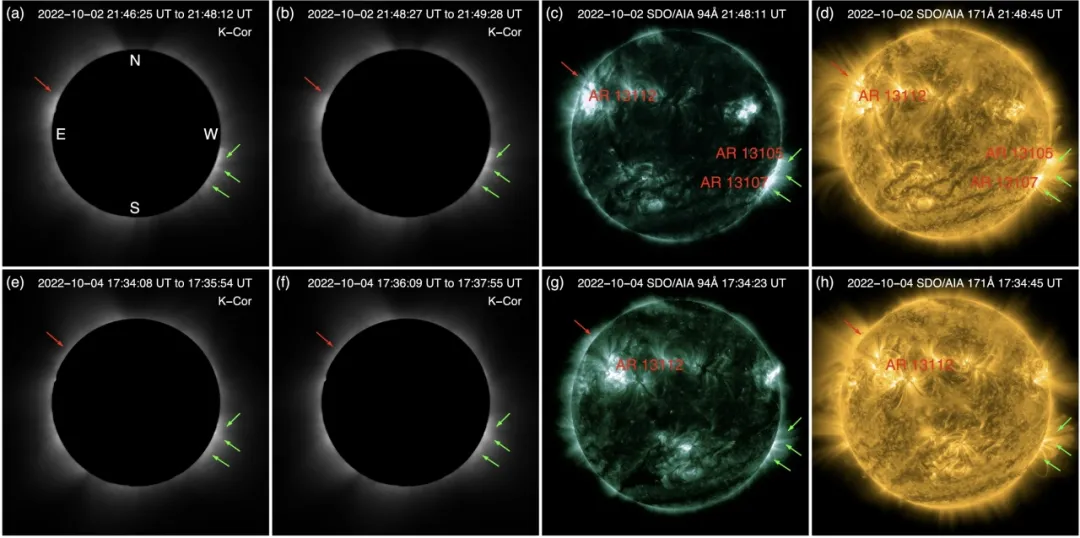
On October 4, 2022, the BBWLC completed its first scientific flight in Dachaidan, Qinghai, China. At approximately 30 km altitude, it captured white-light coronal data across 1.08–1.50 solar radii. Processed images revealed three streamer structures along the western limb of the Sun.
Comparisons with observations from the High Altitude Observatory's K-Coronagraph and NASA's Solar Dynamics Observatory supported the identification of the white-light corona. The mission also established valuable engineering experience in optical design, pointing control, environmental adaptation, and data processing.
Why choose Dhyana 95V2 for solar coronagraph imaging?
Successful coronal imaging depends on more than a single component. A suitable scientific camera must work with the optical system and data processing workflow to support reliable observations.
Dhyana 95 demonstrates its relevance to the development and testing of demanding scientific imaging systems. For researchers exploring solar coronagraphs, astronomical observation, and other low-light applications, selecting the right detector is an important step toward obtaining useful scientific data.
● 95% peak QE and 1.6 e⁻ read noise: Supports the detection of weak optical signals.
● 100 ke⁻ full-well capacity and 90 dB dynamic range: Helps accommodate large differences in signal intensity.
● Stable cooling: Helps control temperature-related response variations during imaging.
● Reliability for demanding environments: Engineering validation supports stable operation under challenging pressure and temperature conditions.
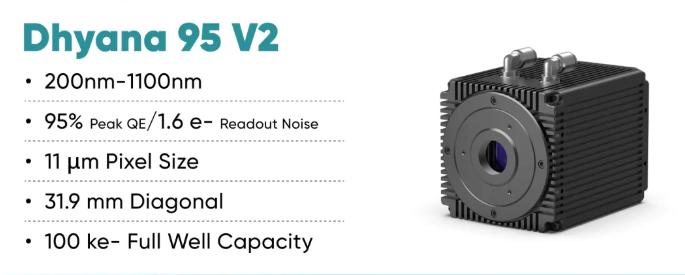
A low noise camera can help improve the visibility of weak signals. Dhyana 95 should be evaluated according to its actual sCMOS specifications and the requirements of each application.
Explore Dhyana 95 to learn more about its capabilities for scientific imaging.
FAQ
What is a solar coronagraph?
A solar coronagraph suppresses direct sunlight to make the much fainter solar corona observable. It is used to study coronal structures close to the solar disk.
What did the BBWLC observe?
During its first scientific flight on October 4, 2022, the BBWLC obtained white-light coronal data across 1.08–1.50 solar radii and revealed three streamer structures along the western limb of the Sun.
What role did Dhyana 95V2 play?
Dhyana 95V2 served as a key detection device in the experiment, supporting scientific image acquisition and subsequent data analysis.
Is Dhyana 95V2 a photon counting camera?
Dhyana 95V2 is an sCMOS scientific camera. A photon counting camera refers to a detector or imaging system designed to identify individual photon events. These terms describe different imaging approaches and should not be used interchangeably.
What should researchers consider when selecting a camera for coronal imaging?
Important factors include sensitivity, noise performance, stray-light control, optical design, and data processing requirements. The appropriate camera depends on the observation target and the complete instrument configuration.
Reference
The First Scientific Flight and Observations of the 50 mm Balloon-borne White-light Coronagraph.
Read the original paper


