

 2026/10/15
Compare a cooled CMOS camera and cooled CCD camera for chemiluminescence imaging. See how Tucsen FL 9BW improves weak-signal detection, SNR, and background control in ultra-low-light applications.
Why Compare Cooled CMOS and CCD?
Chemiluminescence imaging detects extremely weak signals, often requiring exposures from seconds to minutes. In these conditions, dark current, read noise, and background non-uniformity can obscure faint bands or wells.
Cooled CCD cameras have long been the default choice for chemiluminescence. However, modern cooled CMOS technology now offers comparable low-light performance with faster readout and higher resolution.
The key question is: Can a cooled CMOS camera replace a cooled CCD for chemiluminescence imaging?
Datasheet specifications alone cannot answer this. Real performance depends on weak-signal detection, background control, and signal-to-noise ratio (SNR) under actual imaging conditions.
To find out, we compared the FL 9BWcooled CMOS camera with the H-695ICE cooled CCD camera under identical experimental conditions.
The comparison focused on three practical questions:
● Can the camera detect very weak chemiluminescent signals?
● How well does it control background noise during short exposures?
● How do gain and binning affect SNR and image stability?
Both cameras were tested using the same optical system, sample, and exposure time. To ensure a fair comparison, the cameras were first calibrated for equivalent system gain.
FL 9BW and H-695ICE Specification Comparison
|
Specification |
FL 9BW (Cooled CMOS) |
H-695ICE (Cooled CCD) |
|
Sensor type |
BSI CMOS |
CCD |
|
Pixel size |
3.76 µm |
4.54 µm |
|
Resolution |
3000 × 3000 |
2688 × 2200 |
|
Read noise |
0.75–2.5 e- |
4–10 e- |
|
Dark current |
< 0.0005 e-/pixel/s |
0.005 e-/pixel/s |
|
Peak QE |
92% @ 530 nm |
75% @ 600 nm |
|
Cooling temperature |
-25°C at room temperature |
-12°C at room temperature |
The FL 9BW’s <0.0005 e-/pixel/s dark current and deep cooling to -25°C make it suitable for chemiluminescence imaging and other long-exposure imaging applications.
Gain calibration
The FL 9BW CMOS camera and H-695ICE cooled CCD camera use different sensor architectures and gain mechanisms, so their default gain settings cannot be compared directly. Before testing, both cameras were calibrated to match their effective conversion gain in e-/ADU.
|
FL 9BW gain |
Actual gain (e-/ADU) |
H-695ICE gain |
Actual gain (e-/ADU) |
|
0 |
0.75 |
0 |
0.3375 |
|
1 |
0.25 |
67 |
0.2491 |
|
2 |
0.125 |
160 |
0.1265 |
|
3 |
0.063 |
208 |
0.0632 |
For the imaging tests, FL 9BW Gain 1 and Gain 3 were selected to represent low-gain and high-gain operating modes. These were compared with the equivalent gain settings on the H-695ICE cooled CCD camera.
The two cameras also differ in pixel size and quantum efficiency. Based on peak QE, the H-695ICE has a theoretical single-photon detection efficiency approximately 1.2 times higher than the FL 9BW. This difference was not normalized, so the results reflect real-world system-level imaging performance rather than idealized sensor-only performance.
Long-Exposure Chemiluminescence Imaging Test
In the long-exposure test, both cameras captured clear images with stable brightness, visible structural detail, and comparable overall visualization.
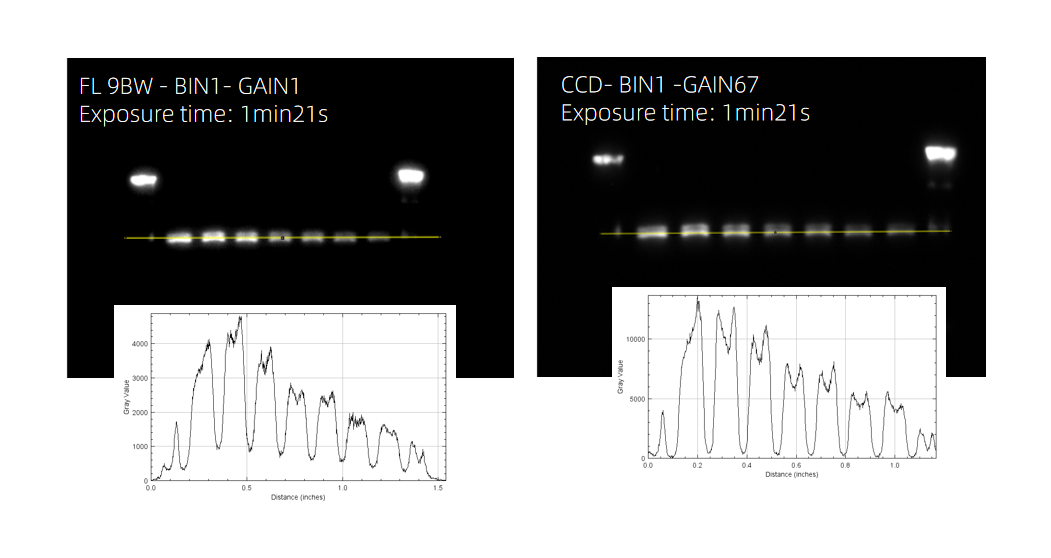
Test conditions: FL 9BW, 1 × 1 binning, Gain 1, 81 s exposure; H-695ICE, 1 × 1 binning, Gain 67, 81 s exposure.
With longer exposure times, the imaging system accumulates more photons. This reduces the relative impact of read noise and allows both the cooled CMOS and cooled CCD cameras to produce usable images. In this regime, the difference between the two technologies is less pronounced.
This result is important for laboratories with established long-exposure protocols: a modern deep-cooled CMOS camera can cover the core use cases traditionally handled by a cooled CCD camera.
Weak-Signal Detection in Low Light Imaging
The short-exposure test better represents challenging chemiluminescence conditions, where only a limited number of photons reach the sensor. At short exposures, read noise and background noise become the main factors limiting weak-signal detection.
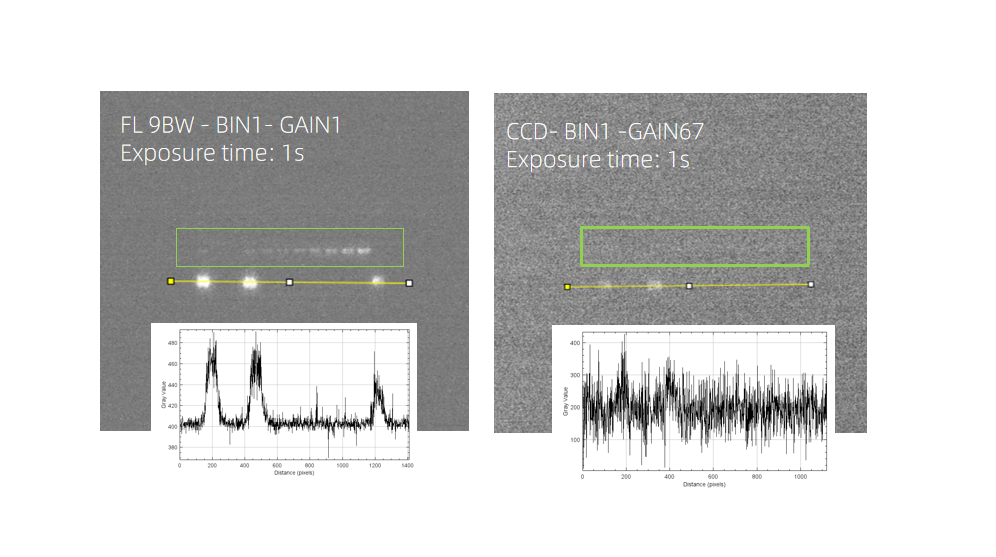
Test conditions: FL 9BW, 1 × 1 binning, Gain 1, 1 s exposure; H-695ICE, 1 × 1 binning, Gain 67, 1 s exposure.
In weak-signal regions below 10 e-, the H-695ICE cooled CCD camera struggled to resolve reliable signal. Background noise increased, and faint structures became difficult to distinguish. In contrast, the FL 9BW maintained clearer weak-signal recognition, a more uniform background, and better structural visibility.
In stronger signal regions around 20 e-, the cooled CCD camera detected the target, but with lower SNR and more visible background fluctuation. The FL 9BW retained higher SNR and more stable structure definition.
For chemiluminescence imaging, this matters because faint bands, low-abundance targets, and early-stage reactions often appear only briefly or at very low signal levels. A high sensitivity camera with better background control can improve confidence in both visual inspection and quantitative analysis.
Gain and binning performance
In extreme low light imaging, users can improve SNR by increasing conversion gain—such as using a high-gain mode—or by applying pixel binning. Both approaches reduce the relative impact of read noise on weak signals and can help shorten exposure time or improve experimental throughput.
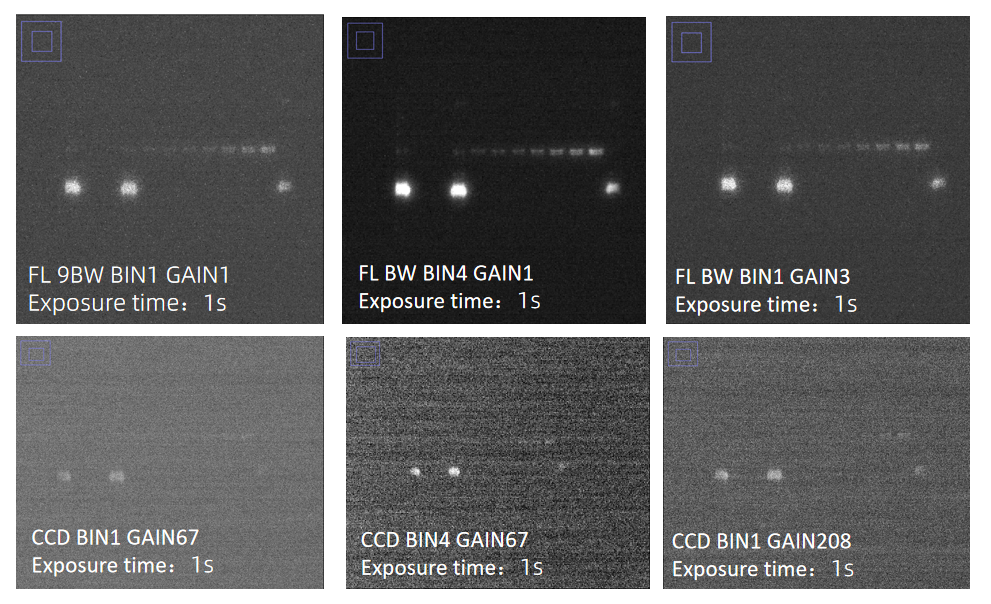
Tucsen compared both cameras across different gain and binning modes under identical exposure conditions.
The results showed that:
● Both cameras achieved better SNR in high-gain mode than in low-gain mode.
● The FL 9BW outperformed the H-695ICE cooled CCD camera in overall SNR and background stability in both low-gain and high-gain modes.
● The advantage remained consistent whether binning was enabled or not.
This indicates that the FL 9BW’s advantage is not dependent on a single setting. Its low-noise deep-cooled CMOS architecture provides a more stable foundation for chemiluminescence imaging across common acquisition configurations.
Is a Scientific CMOS Camera a Replacement for a Cooled CCD?
Both the industry trend and the results of this test support the same conclusion: a cooled CMOS camera is the better choice.
Cooled CCD cameras have long been the conventional choice for chemiluminescence imaging. As image sensor technology has moved toward CMOS, Sony announced its CCD sensor discontinuation plan in 2015, and publicly available information indicates that the final shipment date for certain designated CCD models was March 31, 2026. At the same time, continued improvements in CMOS quantum efficiency, read noise, dark current, and acquisition speed have created a practical basis for using cooled CMOS cameras in chemiluminescence imaging systems.
Under this test conditions, with equivalent gain, identical exposure time, the same optical system, and the same sample, the results show that the FL 9BW is a practical scientific CMOS camera solution for chemiluminescence imaging and can address many scenarios traditionally served by cooled CCD cameras.
For long exposures, both cameras performed comparably and reliably completed typical chemiluminescence imaging tasks. For short exposures and low photon accumulation, the FL 9BW maintained stronger weak signal detection and better background uniformity because of its lower read noise and dark current. This is the range where chemiluminescence quantitative analysis is most demanding. Across gain and binning combinations, the FL 9BW also consistently delivered higher SNR and more stable background performance.
These advantages come from lower read noise, lower dark current, higher quantum efficiency, and deeper cooling. Under the conditions of this test, they address the traditional weaknesses of CMOS sensors in long exposure, low light applications. This makes the FL 9BW a new option for chemiluminescence, bioluminescence, and other ultra low light quantitative imaging applications.
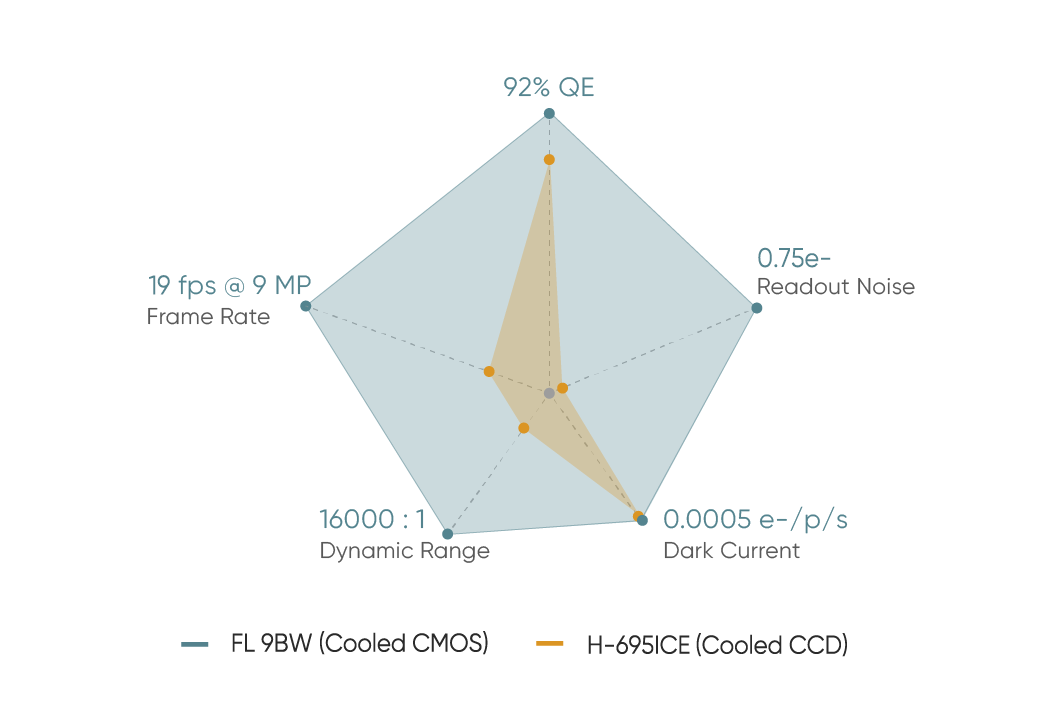
The performance of the FL 9BW (cooled CMOS) and H-695ICE (cooled CCD).
Compared with the cooled CCD camera H-695ICE in this test of Tucsen, the cooled CMOS camera FL 9BW delivered comparable long exposure imaging performance, stronger short exposure performance, and better overall SNR and background stability.
For laboratories planning new chemiluminescence or bioluminescence systems, especially those requiring short exposure, high throughput, or long-term platform scalability, the FL 9BW is worth evaluating as a cooled-CCD alternative. For existing validated CCD-based protocols, a side-by-side validation under the laboratory’s own substrates, filters, and exposure conditions remains recommended.
For further details, please visit the FL 9BW product or contact us. Tucsen’s engineering team can help evaluate camera performance based on your sample type, exposure time, optical system, and signal level.
FAQ
Can a scientific CMOS camera replace a cooled CCD camera for chemiluminescence imaging?
Yes. In this comparison, the FL 9BW deep-cooled scientific CMOS camera outperformed a cooled CCD camera in weak-signal detection, background stability, and SNR under equivalent test conditions. It is suitable for many chemiluminescence and bioluminescence imaging workflows traditionally performed with cooled CCD cameras.
Why is deep cooling important for low light imaging?
Deep cooling reduces dark current, which is especially important during long exposures. The FL 9BW cools to -25°C at room temperature and achieves dark current below 0.0005 e-/pixel/s, helping maintain clean backgrounds during extended chemiluminescence acquisitions.
When should I use high gain or binning?
Use high gain when your signal is very weak and you want to minimize the impact of read noise. Use binning when you can accept reduced spatial resolution in exchange for improved SNR. Both methods can be useful for faint chemiluminescent bands or low-photon signals.
Is the FL 9BW suitable for bioluminescence imaging?
Yes. Bioluminescence imaging often requires long exposures, high sensitivity, and very low background noise. The FL 9BW’s low dark current, deep cooling, high QE, and low read noise make it a strong candidate for a camera for bioluminescence imaging as well as chemiluminescence imaging.
What makes the FL 9BW different from a conventional CMOS camera?
The FL 9BW is a scientific CMOS camera designed for long-exposure, ultra-low-light imaging. It combines a back-illuminated CMOS sensor, deep cooling, low dark current, low read noise, and flexible gain and binning modes,features specifically relevant to chemiluminescence and bioluminescence applications.


