

 2026/10/23
Highlights
● Nearly 60% less body volume than the deep-cooled Aries 6504. Over 80% lower power consumption for easier system integration.
● 83% peak QE and 0.8 e⁻ readout noise for improved low-light imaging.
● Up to 100 fps at 2048 × 2048 resolution, 2.5× faster than the previous generation.
● Now available for demo and sample testing.
Can a Compact Camera Deliver Higher Sensitivity and Faster Imaging?
What if you could integrate a high-performance sCMOS camera into a smaller system without compromising sensitivity or acquisition speed?
For developers of scientific instruments and industrial inspection systems, camera performance is only part of the challenge. Size, power consumption, and thermal management also affect system design.
The Tucsen Aries 6504 LT addresses these demands with a compact design, improved low-light sensitivity, and faster image acquisition. Compared with the previous-generation compact camera Dhyana 401D, it delivers higher quantum efficiency, lower readout noise, and a higher frame rate. It also offers a smaller footprint and lower power consumption than the deep-cooled Aries 6504.
Now available for demo and sample testing, the Aries 6504 LT gives you the opportunity to evaluate its performance in your own application. Contact our engineering team to discuss your imaging requirements.
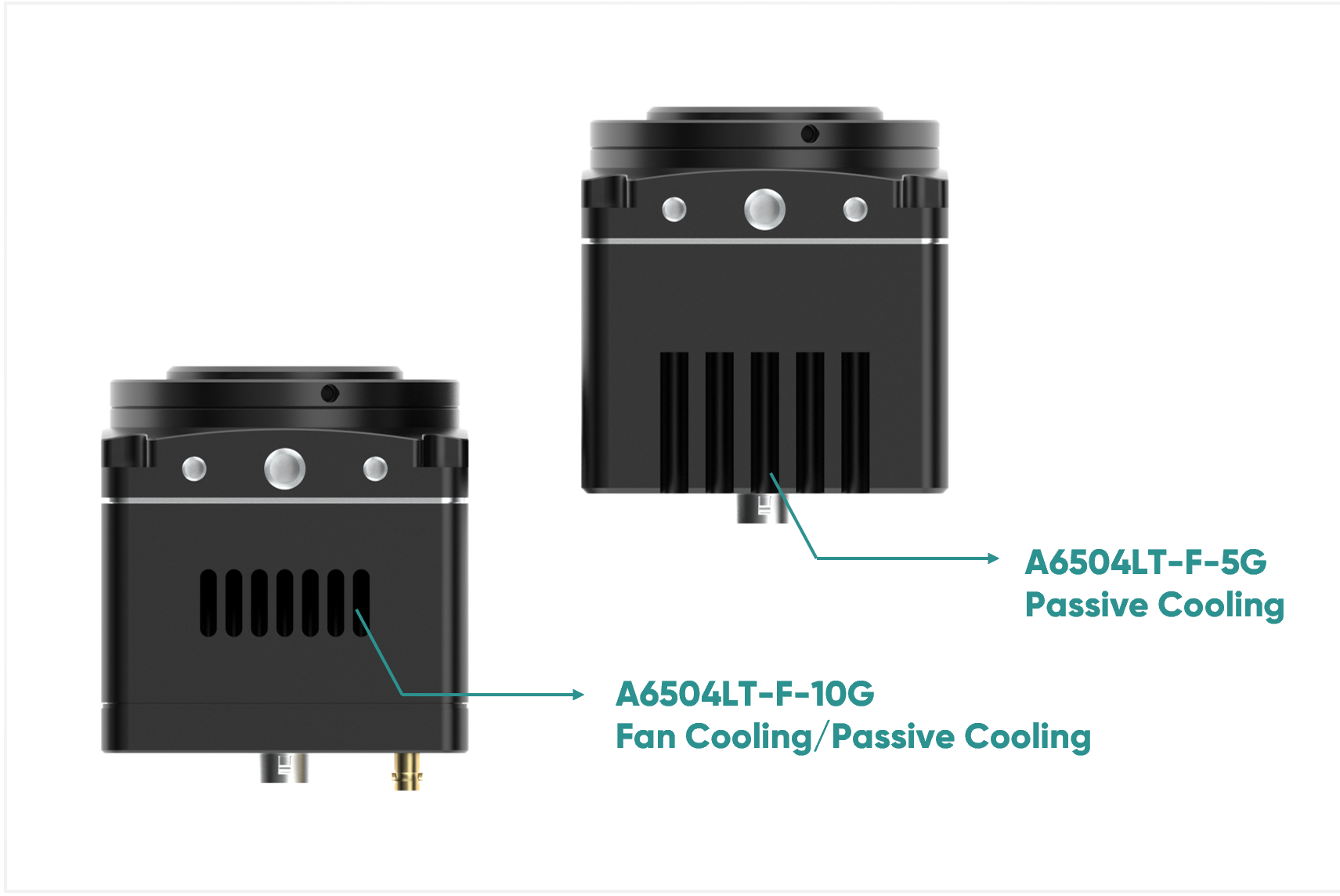
Aries 6504 LT product image. The series is available in 5G and 10G models to meet different system integration requirements.
How Does Its Compact Design Simplify Integration?
The Aries 6504 LT measures just 65 × 65 × 66 mm, reducing body volume by nearly 60% compared with the deep-cooled Aries 6504.
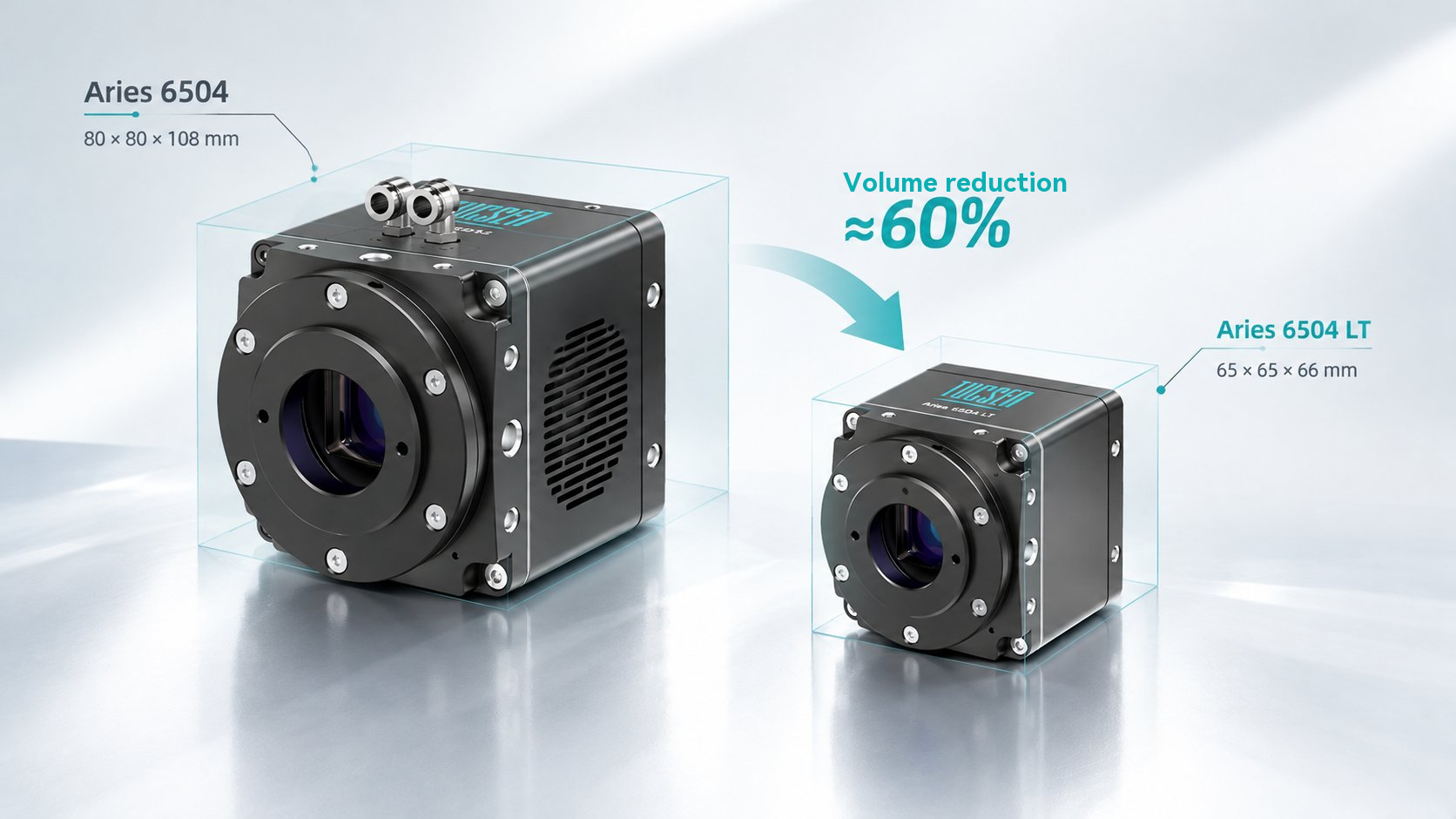
Structural design and power consumption comparison between the Aries 6504 LT and the deep-cooled Aries 6504.
Power consumption is also significantly lower. The 5G model consumes less than 6 W, while the 10G model consumes less than 12 W. Both deliver over 80% lower power consumption than the deep-cooled Aries 6504, rated at a maximum of 60 W.
For OEM developers, these improvements make it easier to manage space, cooling, and power requirements. The Aries 6504 LT is a practical compact camera for scientific instruments, integrated imaging systems and machine vision equipment.
How Much Has Low-Light Imaging Performance Improved with the previous compact camera
In fluorescence microscopy and other low-light applications, quantum efficiency and readout noise directly affect the ability to capture weak signals.
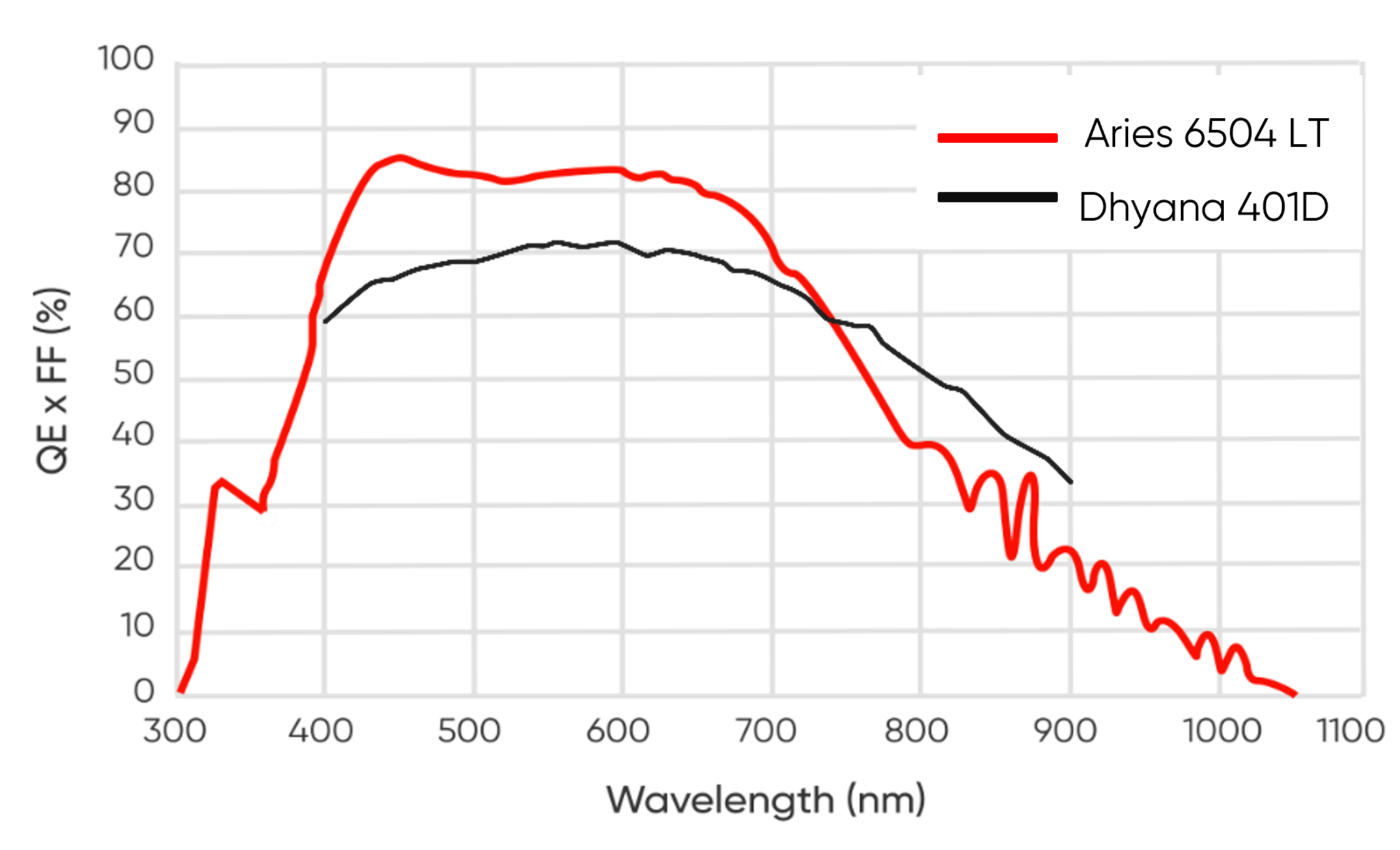
Quantum efficiency curves of the Aries 6504 LT and the Dhyana 401D.
Compared with the Dhyana 401D, the Aries 6504 LT increases peak quantum efficiency from 72% to 83%. Readout noise drops from 2.1 e⁻ to 0.8 e⁻. Its broader spectral response also supports a wider range of imaging applications.
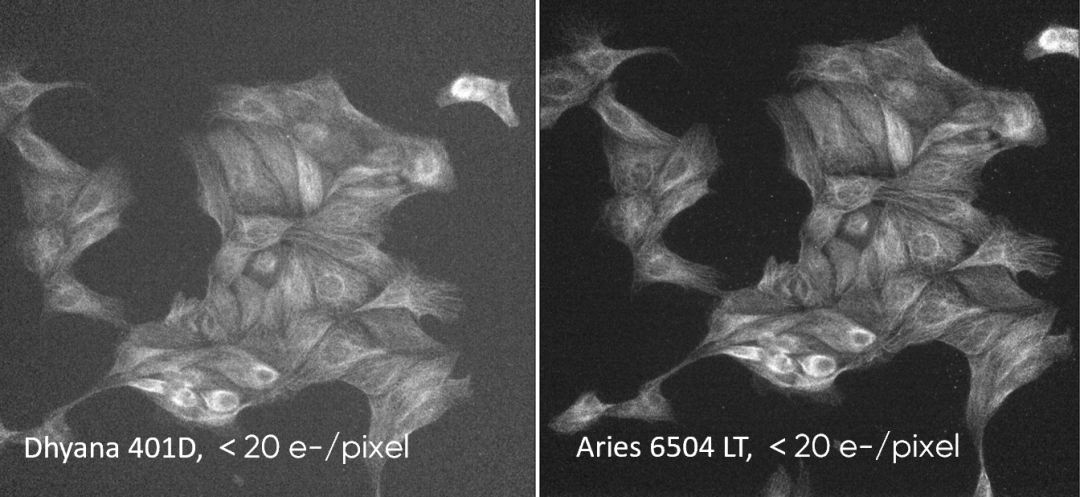
Low-light imaging comparison between the Aries 6504 LT and the Dhyana 401D.
Together, these improvements help capture weak signals with a higher signal-to-noise ratio under the same imaging conditions. This makes the Aries 6504 LT well suited to demanding scientific imaging and fluorescence microscopy workflows.
How Does Faster Acquisition Improve Inspection Efficiency with the previous compact camera
The Aries 6504 LT reaches up to 100 fps at 2048 × 2048 resolution, 2.5 times the frame rate of the previous generation.
Higher acquisition speed helps capture fast-changing events and supports greater throughput in time-sensitive applications. For industrial inspection and machine vision, this provides more flexibility when imaging moving samples or handling demanding acquisition tasks.
Beyond faster acquisition, the Aries 6504 LT features a 60% smaller footprint, simplified FPGA architecture, and no liquid cooling requirement. These design improvements make it easier to integrate into vibration-sensitive systems such as live-cell fluorescence imaging and precision semiconductor metrology.
The 5G version uses passive cooling, while the 10G version comes with fan cooling by default, which can be removed to enable passive cooling. Fanless operation helps minimize mechanical vibration, supporting more stable imaging in sensitive inspection environments.
Ready to Evaluate the Aries 6504 LT?
Specifications tell you what a camera can deliver. A demo helps you understand how it performs in your application.
The Aries 6504 LT is now available for demo and sample testing. If you are developing a compact scientific instrument, a fluorescence microscopy system, or an industrial camera for machine vision, contact our engineering team to discuss your imaging requirements!


