

 2025/09/30
In scientific research, image quality depends on more than resolution or sensor size. A camera must collect enough signal and separate that signal from unwanted noise.
Signal-to-Noise Ratio (SNR) is one of the most important metrics for evaluating image quality. It describes how clearly useful information can be separated from noise in an image.
In scientific imaging, a high SNR is essential for detecting weak signals, maintaining image contrast, and achieving accurate measurements. A low SNR can hide important details in noise, reducing the reliability of imaging results.
This article explains what SNR is, how it is calculated, which factors affect SNR in scientific cameras, and why it matters for scientific imaging.
What Is Signal-to-Noise Ratio (SNR)?
Signal-to-Noise Ratio (SNR) measures the relationship between the useful signal captured by a camera and the unwanted noise generated during image acquisition.
In simple terms, SNR describes the difference between what you want to measure and what interferes with that measurement.
A higher SNR means the signal is easier to distinguish from background noise. A lower SNR means noise becomes more significant and can affect image quality.
SNR is fundamental to image contrast and is often an important factor in determining whether a camera is sensitive enough for a specific application.
In scientific imaging, SNR is not a fixed value for an entire image. The signal level can vary between different pixels, depending on the sample and imaging conditions.
For example, in fluorescence microscopy, the SNR of an image usually refers to the peak signal intensity from the pixels containing the fluorescent structure of interest. Pixels in a dark background area may contain little or no signal, resulting in a much lower SNR.
Therefore, using an average value across the entire image may not accurately represent the SNR of the region that matters.
How Is Signal-to-Noise Ratio Calculated?
The basic definition of SNR is the ratio between signal and noise:
SNR = Signal / Noise
This relationship shows that SNR can be improved in two ways: increasing the detected signal or reducing the noise level.
Increasing signal can be achieved through factors such as higher quantum efficiency, larger pixel size, or longer exposure time.
Reducing noise requires understanding the different noise sources generated during image acquisition.
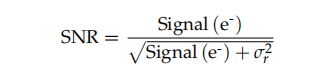
Signal-to-noise ratio with dark current
The following is the equation to use in situations where dark current noise is large enough to require inclusion:

Here is the definition of terms:
Signal (e-): This is the signal of interest in photoelectrons, with the dark current signal subtracted

The Total signal (e-) will be the photoelectron count in the pixel of interest – strictly not the pixel value in units of gray levels.The second instance of the Signal (e-), on the bottom of the equation, is the photonshot noise.
Dark current (DC): The dark current value for that pixel.
t: Exposure time in seconds
σr: Read noise in camera mode.
Signal-to-noise ratio for negligible dark current
In the cases of short (< 1 second) exposure times, plus cooled, high-performance cameras, dark current noise will generally be well below read noise, and safely neglected.
Where terms are once again as defined above, with the exception that the dark current signal need not be calculated and subtracted from the signal as it should equal zero.
How Does SNR Influence Image Contrast?
Contrast is the relative difference in intensity between light areas and dark areas of an image. For many applications, good image contrast within areas of interest is the ultimate end goal.
There are many factors within the imaging subject, optical system and imaging conditions that are the primary determining factors of image contrast, such as lens quality and amount of background light.
● High SNR → Distinct separation between bright and dark regions; edges appear crisp; subtle details remain visible.
● Low SNR → Dark areas get brighter due to noise, bright areas get dimmer, and overall image contrast flattens.
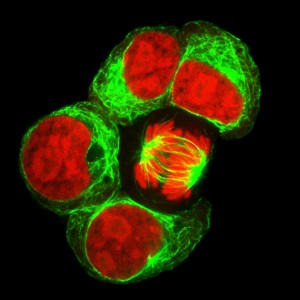
For example, in fluorescence microscopy, low SNR can make a weakly fluorescent sample blend into the background, making quantitative analysis unreliable. In astronomy, faint stars or galaxies can disappear entirely in noisy data.
However, there are also factors within the camera itself – the primary factor being the Signal to Noise Ratio. Further, and especially at low light, image intensity scaling, how the image is displayed on the monitor, plays a large role in the perceived image contrast. With high noise in dark areas of the image, auto image scaling algorithms can have their lower bound set too low by low-value noisy pixels, while the high bound is increased by noise in high signal pixels. This is the cause of the characteristic ‘washed-out’ gray appearance of low-SNR images. Better contrast can be obtained by setting the lower bound to the camera offset.
What Factors Affect SNR in Scientific Cameras?
The final SNR of a scientific camera system depends on both signal collection and noise control.
Quantum Efficiency (QE)
Quantum efficiency describes how effectively a sensor converts incoming photons into electrons. A higher QE allows the camera to collect more useful signal from the same amount of light, improving SNR. More information about quantum efficiency.
Pixel Size and Fill Factor
Larger pixels can collect more photons during exposure.Increasing the collected photon signal improves the signal level and can increase SNR. More information about pixel size.
Exposure Time
Longer exposure times allow more photons to be collected, increasing the available signal.However, longer exposures can also increase dark current noise, especially without sufficient cooling.
Cooling Systems
Cooling reduces dark current generated inside the sensor.For long-exposure imaging, reducing dark current can significantly improve SNR and help preserve weak signals.
Sensor Technology
Different sensor technologies have different noise characteristics.
CMOS: CMOS sensors offer fast readout speeds and low power consumption. They are widely used in general-purpose imaging applications.
sCMOS: sCMOS cameras combine low readout noise with high frame rates, making them suitable for dynamic imaging applications such as live cell imaging and high-speed microscopy.
EMCCD: EMCCD cameras use on-chip amplification to enhance weak signals before readout. They excel in ultra-low-light applications but can introduce additional multiplicative noise.
CCD: CCD cameras have historically provided low noise performance for long exposures but are generally slower than modern CMOS designs. Sony has discontinued its CCD sensor lines, and most new systems now use CMOS, sCMOS, or EMCCD.
Optics and Illumination
The optical system also affects the available signal.
High-quality optics and stable illumination help maximize signal collection and reduce variations during imaging.
Understanding Different SNR Levels Through Example Images
Different SNR values can produce significant differences in image appearance.
For conventional scientific cameras, images with similar SNR values can show similar characteristics, including graininess, frame-to-frame variation, and contrast differences.
The following examples demonstrate how different peak SNR values affect image visibility and stability.
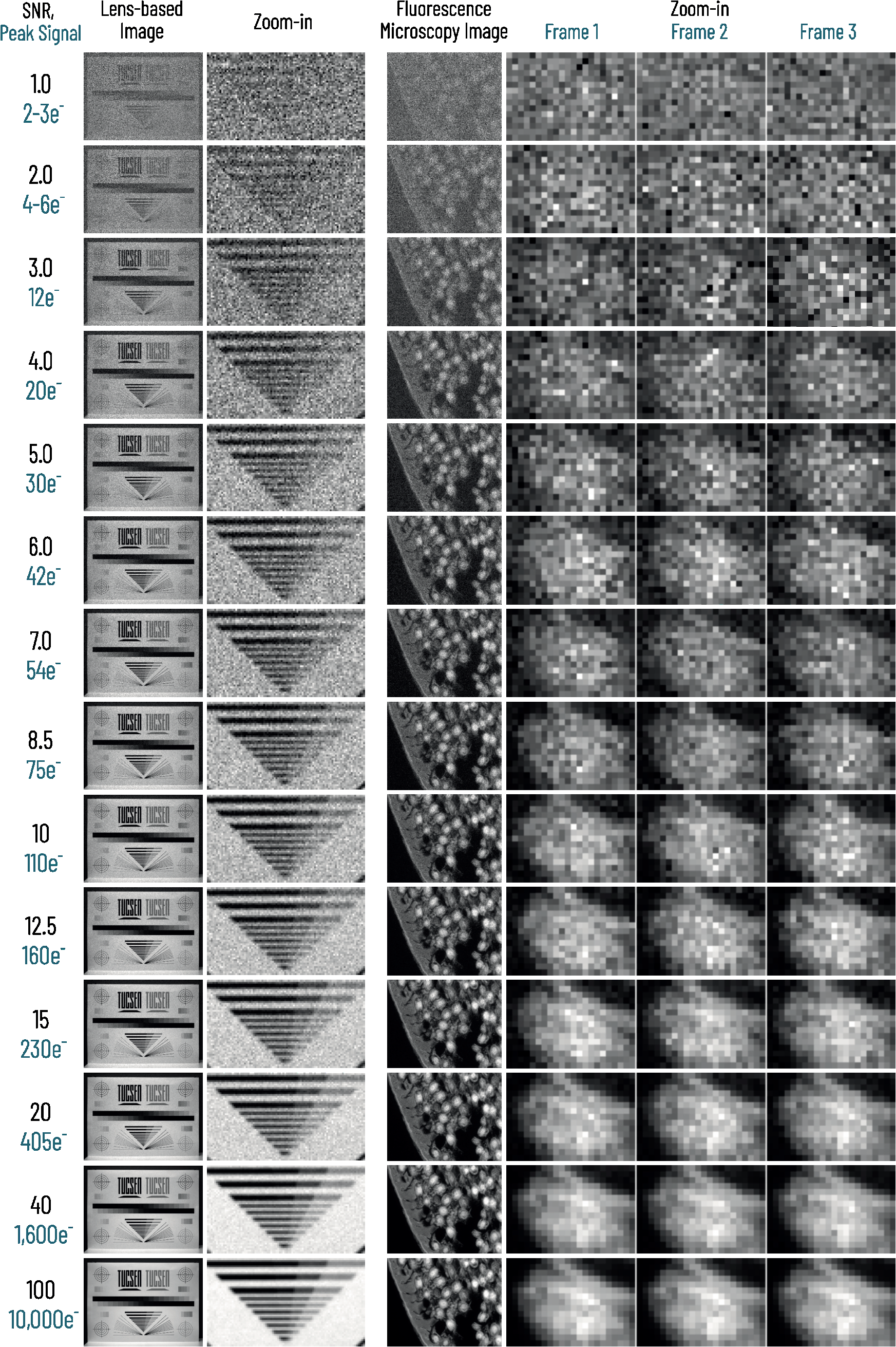
NOTE: Peak signal values in photoelectrons for each row are provided in blue. All images are displayed with auto histogram scaling, ignoring 0.35% of the brightest and darkest pixels.
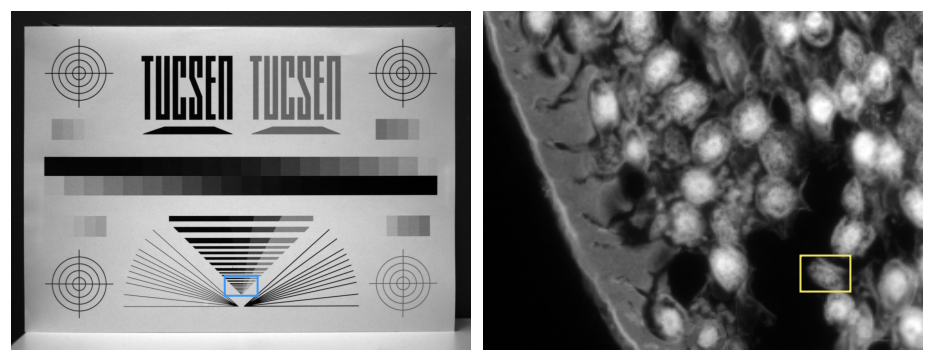
Left: An imaging test target photographed with a lens.
Right: A sample of Ascaris nematode worm section viewed with fluorescence microscopy at 10x magnification.
|
|
|
|
 |
|
 |
Where High SNR Makes a Difference in Scientific Imaging
A high signal-to-noise ratio is important whenever the target signal is weak or accurate measurement is required.
Applications that benefit from high SNR include:
● Detecting weak signals that may otherwise be hidden by noise
● Maintaining clear image details under low-light conditions
● Improving the reliability of quantitative measurements
● Capturing consistent results when signal levels are limited
Selecting a camera with appropriate noise performance, such as a low noise sCMOS camera, can help improve imaging reliability in demanding applications.
Choosing a Scientific Camera with the Right SNR
SNR is an important parameter when evaluating scientific cameras, but it should be considered together with other camera characteristics.
When comparing cameras, consider:
● SNR performance under conditions similar to your application
● Quantum efficiency, dynamic range, and frame rate
● Sensor technology and imaging requirements
● Exposure conditions and noise sources that may limit performance
A camera with the right balance of signal collection and noise control can help achieve reliable scientific imaging results.
Not sure which sensor technology fits your needs? Ask our imaging engineers for camera selection guidance.
Conclusion
Signal-to-Noise Ratio (SNR) is a key performance metric that directly influences the clarity and reliability of scientific images. Understanding how SNR is defined, the factors that affect it, and the implications of different SNR values allows researchers and technical users to evaluate imaging systems more effectively. By applying this knowledge—whether in selecting a new scientific camera or optimizing an existing setup—you can ensure that your imaging workflow captures data with the level of precision required for your specific application.
FAQs
What is considered a "good" SNR for scientific cameras?
The ideal SNR depends on the application. For highly demanding, quantitative work—such as fluorescence microscopy or astronomy—an SNR above 40 dB is generally recommended, as it produces images with minimal visible noise and preserves fine details. For general laboratory use or industrial inspection, 35–40 dB can be sufficient. Anything below 30 dB will typically show visible grain and can compromise accuracy, especially in low-contrast situations.
How does quantum efficiency (QE) affect SNR?
Quantum efficiency measures how effectively a sensor converts incoming photons into electrons. A higher QE means more of the available light is captured as signal, boosting the numerator in the SNR equation. This is especially important in low-light scenarios, where every photon counts. For example, a sCMOS camera with a QE of 80% will achieve higher SNR under identical conditions compared to a sensor with 50% QE, simply because it captures more usable signal.
What’s the difference between SNR and Contrast-to-Noise Ratio (CNR)?
While SNR measures the overall signal strength relative to noise, CNR focuses on the visibility of a specific feature against its background. In scientific imaging, both are important: SNR tells you how “clean” the image is overall, while CNR determines whether a particular object of interest stands out enough for detection or measurement.
Want to learn more? Take a look at related articles:
Quantum Efficiency in Scientific Cameras: A Beginner’s Guide
Tucsen Photonics Co., Ltd. All rights reserved. When citing, please acknowledge the source: www.tucsen.com


