

 2025/07/31
Although in 2025, CMOS sensors dominate scientific and consumer imaging alike, this was not always the case.
CCD stands for 'Charge-Coupled Device', and CCD sensors were the original digital camera sensors, first developed in 1970. CCD- and EMCCD-based cameras were commonly recommended for scientific applications up until just a few years ago. Both technologies still survive today, though their uses have become niche.
The rate of improvement and development of CMOS sensors continues to increase. The difference between these technologies lies primarily in the way they process and read out detected electronic charge.
What Is a CCD Sensor?
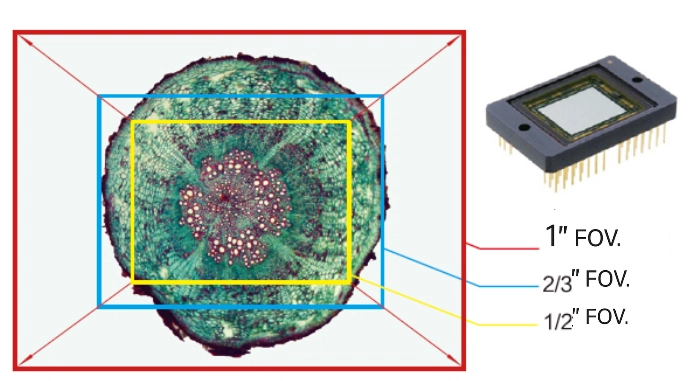
CCD sensor is a type of image sensor used to capture light and convert it into digital signals. It consists of an array of light-sensitive pixels that collect photons and turn them into electrical charges.
CCD sensor readout differs from CMOS in three significant ways:
● Charge Transfer: Photoelectrons captured are electrostatically moved pixel-to-pixel across the sensor to a readout area at the bottom.
● Readout Mechanism: Instead of an entire row of analogue to digital converters (ADCs) operating in parallel, CCDs use just one or two ADCs (or sometimes more) that read pixels sequentially.
Capacitor and Amplifier Placement: In place of capacitors and amplifiers in each pixel, each ADC has one capacitor and amplifier.
How Does a CCD Sensor Work?
Here’s how a CCD sensor works to acquire and process an image:
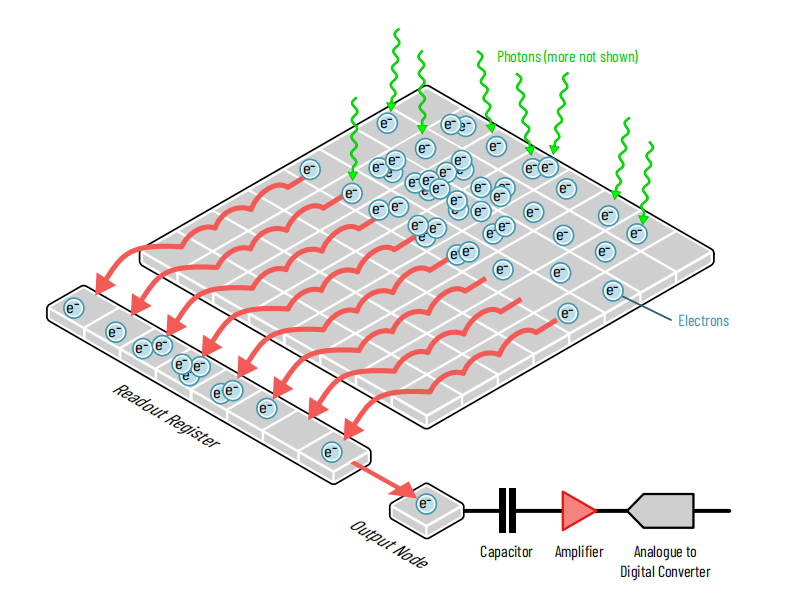
At the end of their exposure, CCD sensors first move collected charges to within a masked storage area inside each pixel (not shown). Then, one row at a time, charges are moved into a readout register. One column at a time, charges within the readout register are read out.
1. Charge Clearing: To begin the acquisition, charge is simultaneously cleared from the whole sensor (global shutter).
2. Charge Accumulation: Charge accumulates during exposure.
3. Charge Storage: At the end of exposure, collected charges are moved to a masked area of within each pixel (called interline transfer CCD), where they can await readout without new detected photons being counted.
4. Exposure of Next Frame: With the detected charges stored in the masked area of pixels, the active area of pixels can begin the exposure of the next frame (overlap mode).
5. Sequential Readout: One row at a time, charges from each row of the finished frame are moved into a 'readout register'.
6. Final Readout: One column at a time, charges from each pixel are shuttled into the readout node for readout at the ADC.
7. Repetition: This process repeats until detected charges in all pixels are counted.
This bottleneck caused by all detected charges being read by a small number (sometimes one) of readout points, leads to to severe limitations in the data throughput of CCD sensors compared to CMOS.
Pros and Cons of CCD Sensors
|
Pros |
Cons |
|
Low Dark Current Typically ~0.001 e⁻/p/s when cooled. |
Limited Speed Typical throughput ~20 MP/s — much slower than CMOS. |
|
On-Pixel Binning Charges are summed before readout, reducing noise. |
High Read Noise 5–10 e⁻ is common due to single-point ADC readout. |
|
Global Shutter True global or near-global shutter in interline/frame-transfer CCDs. |
Larger Pixel Sizes Cannot match the miniaturization CMOS offers. |
|
High Image Uniformity Excellent for quantitative imaging. |
High Power Consumption Requires more power for charge shifting and readout. |
Pros of CCD Sensor
● Low dark Current: Inherently as a technology, CCD sensors tend to have very low dark current, typically on the order of 0.001 e-/p/s when cooled.
● 'On-pixel' Binning: When binning(Rear more about what is binning), CCDs add charges before readout, not after, meaning no additional read noise is introduced. Dark current does increase, but as noted above, this is usually very low.
● Global Shutter: 'Interline' CCD sensors operate with a true global shutter. 'Frame Transfer' CCD sensors use a 'half global' shutter (see 'Masked' region of Figure 45) – frame transfer process to start and end exposure is not truly simultaneous, but typically takes on the order of 1-10 microseconds. Some CCDs use mechanical shuttering.
Cons of CCD Sensors
● Limited Speed: typical data throughput in pixels per second can be around 20 Megapixels per second (MP/s), equivalent to a 4 MP image at 5 fps. This is around 20x slower than equivalent CMOS, and at least 100x slower than high-speed CMOS.
● High Read Noise: Read noise in CCDs is high, largely due to the need to run the ADC(s) at a high rate to achieve usable camera speed. 5 to 10 e- is common for high-end CCD cameras.
● Larger Pixels: For many applications, smaller pixels provide advantages. Typical CMOS architecture allows smaller minimum pixel sizes than CCD.
● High Power Consumption: The power requirements for running CCD sensors are much higher than CMOS.
Where Were CCD Sensors Used in Imaging?
CCD sensors dominated scientific and industrial imaging for decades. Their ability to capture low-light signals with minimal noise made them the preferred choice for precision applications.
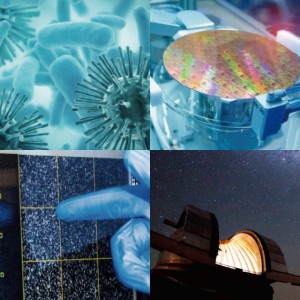
Astronomy
CCD sensors captured faint light from distant stars and galaxies. They were widely used in observatories and in advanced amateur astronomy for long-exposure astrophotography, delivering clear, detailed images.
Microscopy and Life Sciences
In life sciences, CCD sensors are used to capture weak fluorescence signals or subtle cellular structures. Their high sensitivity and uniformity suited applications such as fluorescence microscopy, live cell imaging, and digital pathology. Their linear light response supported accurate quantitative analysis.
Semiconductor Inspection
CCD sensors were used in semiconductor manufacturing, mainly for wafer inspection. Their high resolution and consistent imaging quality helped identify micro-scale defects in chips, supporting the precision that semiconductor production requires.But TDI cameras become more popular in industry inspection.
Industrial and Machine Inspection
Beyond science, CCD sensors supported industrial imaging. In production-line quality control and machine vision, their consistent response and low noise helped detect small defects on surfaces, components, and assembled products.
X-ray and Scientific Imaging
CCD sensors also appeared in X-ray detection systems and other specialized imaging. Their high signal-to-noise ratio, especially when cooled, was valuable in challenging conditions such as crystallography, materials analysis, and non-destructive testing.
Is CCD Still Relevant Today?
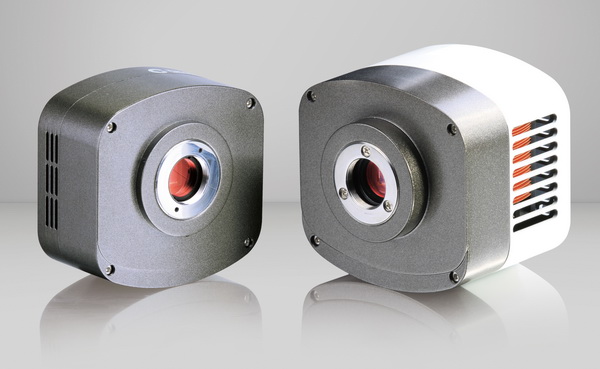
Tucsen H-694 & 674 CCD Camera
The imaging industry has largely moved on from CCD. Sony has discontinued its CCD sensor lines, and CCD performance no longer matches the sensitivity, speed, and functionality of CMOS sensors, sCMOS sensors, or EMCCD sensors. For ultra-low-light applications, EMCCD cameras now deliver far better results than CCD. For most new systems, a CMOS or sCMOS camera offers better performance at a similar or lower cost.
CCD sensors are not fully obsolete. Existing systems still rely on them, and some niche applications continue to use CCD cameras. But for new projects, the choice has shifted decisively toward CMOS, sCMOS, and EMCCD.
Choosing the right sensor comes down to your application. Not sure whether CCD, CMOS, or sCMOS fits your needs? Read our scientific cameras guide to compare the key differences, or ask our imaging engineers for camera selection guidance.
FAQs
When should I choose a CCD sensor?
CCD sensors are much rarer today than ten years ago, as CMOS technology begins to encroach on even their low dark current performance. However, there will always be applications where their combination of performance characteristics—such as superior image quality, low noise, and high sensitivity—provides an advantage
Why do scientific cameras use cooled CCD sensors?
Cooling reduces thermal noise during image capture, improving image clarity and sensitivity. This is particularly important for low-light and long-exposure scientific imaging, which is why many high-end scientific cameras rely on cooled CCDs for cleaner, more accurate results.
What is overlap mode in CCD and EMCCD sensors, and how does it improve camera performance?
CCD and EMCCD sensors are typically capable of ‘overlap mode’. For global shutter cameras, this refers to the ability to read out the previous frame during the exposure of the next frame. This leads to a high (near 100%) duty cycle, meaning minimal time is wasted not exposing frames to light, and hence higher frame rates.
Note: Overlap mode has a different meaning for rolling shutter sensors.
If you want to learn more about rolling shutters, please click:


